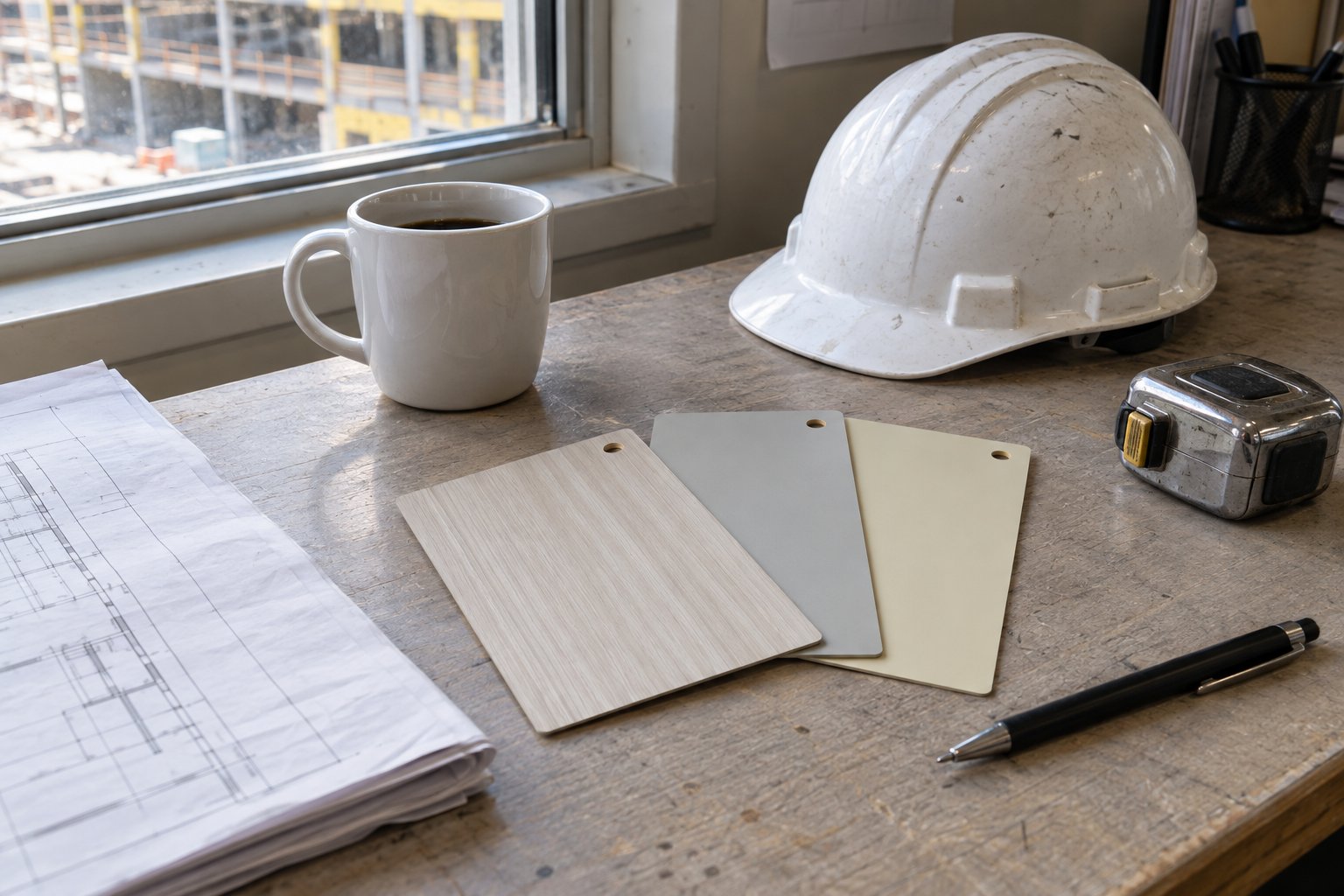
Staged visualization. The sample chips reproduce our actual colours AW002, AS011 and AS013 (full colour range).
When a Korean fire certificate lands on a North American specifier's desk, the first question is predictable: "Is this Class A?" The honest answer, and the one we give our own buyers, is: comparable level, not the same paper. This post explains what maps, what doesn't, and what to do about it.
Two different questions about fire
The US system and the Korean system ask different questions of a material.
- US Class A/B/C rests on ASTM E84, the tunnel test: a specimen is mounted in a tunnel and the test measures how far flame spreads along its surface, plus smoke development. The International Building Code then prescribes minimum classes by occupancy and location, with escape routes held to the strictest class.
- Korean quasi-non-combustible rests on the cone calorimeter (KS F ISO 5660-1): a specimen under radiant heat, measured for how much heat it releases over ten minutes, plus a separate gas-toxicity test on the combustion fumes. We published the actual thresholds and our measured values in Inside a Korean KFI fire test report.
Flame spread and heat release correlate, but they are not the same physical quantity. Of the five markets we compare on our standards page, the US is where the mapping is least precise; Japan shares Korea's exact test method, the EU and China at least share a heat-and-smoke philosophy, while E84 measures something structurally different. That is why we write "comparable to Class A," never "equals Class A."
What this means for your project
Practically, three situations cover most cases.
- Your spec sheet names ASTM E84 explicitly. A Korean certificate cannot substitute on paper, no matter how good the numbers are. The material would need E84 testing, or you need the authority having jurisdiction to accept foreign documentation; some do, case by case. Ask before ordering, not after.
- Your spec asks for "fire-rated interior finish" generically. Here the KFI certificate plus test report often works as evidence of performance, especially with the measured values attached. This is where publishing the actual numbers, rather than a marketing badge, earns its keep.
- You are benchmarking materials, not filing paperwork. Then the comparison is fair game: a film whose measured heat release stays inside the ceiling on every specimen in the Korean test is telling you something real about its behaviour, whatever the certification regime.
One market note: Korean-made architectural films are already sold in North America with US ratings, so the category "fire-rated film with US paperwork" exists; the question is always which paper a specific product carries. Ours carries KFI, and we say so plainly. If your project needs the US paper, E84 testing is a route we can open for a specific project. What the KFI package already gives you is published measured values (3.20 to 6.79 MJ/m² against an 8 MJ/m² ceiling), plus PVC-free chemistry that a US rating alone does not tell you about.
The line we won't cross
You will notice what this post does not claim: it does not quote a flame-spread index for our film (we have not run E84, so there is no number to quote), and it does not call any rating "non-combustible"; quasi-non-combustible means heat release stayed under legal limits in a defined test, not that the material cannot burn.
If your project needs the Korean documentation package, the certificate and test report scans are in our certificates section. If you need to talk through what your AHJ will accept, write to us; we would rather sort the paperwork out before the film ships than after.
YEILDECO
Fire-rated, PVC-free architectural film
Semi-non-combustible (KFI-certified), PVC-free interior film from Korea. We welcome distributor and export inquiries.