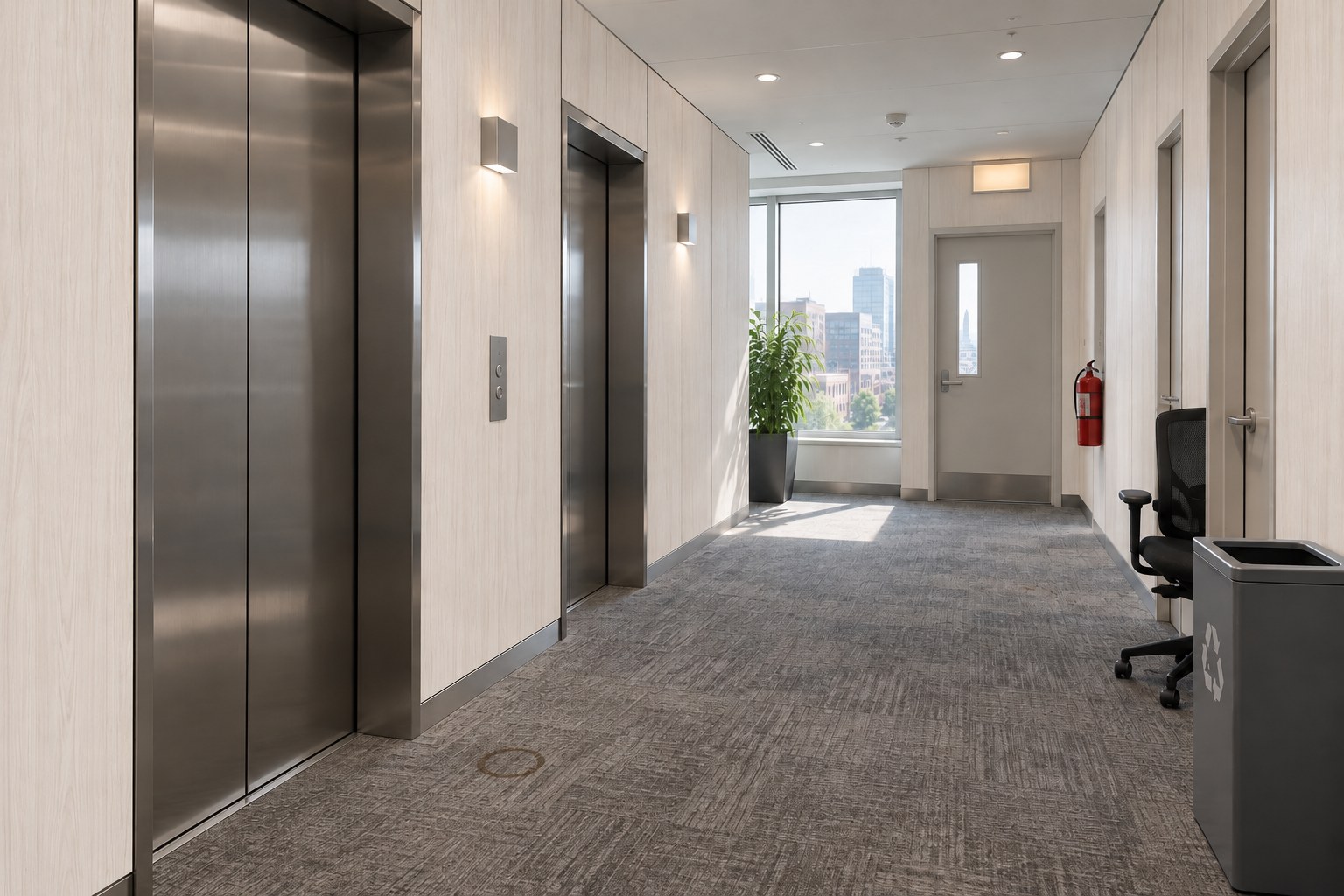
Staged visualization. The film colour reproduces our actual colour AW002.
If you're importing or specifying an interior wall or ceiling finish across markets, you'll run into two different fire vocabularies. American projects talk about "Class A." British and European ones talk about "B-s1,d0." They're answering the same question (how does this surface behave when fire reaches it?) in two systems. Here's how to read both.
The US system: ASTM E84 and Class A/B/C
In the United States, interior wall and ceiling finishes are classified by the Steiner tunnel test, ASTM E84. It measures two things while flame is applied to a sample: how far and fast flame spreads (the Flame Spread Index) and how much smoke develops (the Smoke Developed Index). The flame-spread result sorts materials into three classes (classification per ASTM E84, up.codes):
- Class A: flame spread 0–25
- Class B: flame spread 26–75
- Class C: flame spread 76–200
The lower the number, the less the surface carries flame. The International Building Code (IBC §803) then ties those classes to where a material may be used: the more demanding the occupancy and the more critical the escape route, the higher the class required. A finish headed for an exit corridor in an assembly or institutional building faces a stricter bar than one in a small private room.
Class A doesn't mean "won't burn." It means the surface stays at the low end of flame spread under the test. Hold onto that distinction.
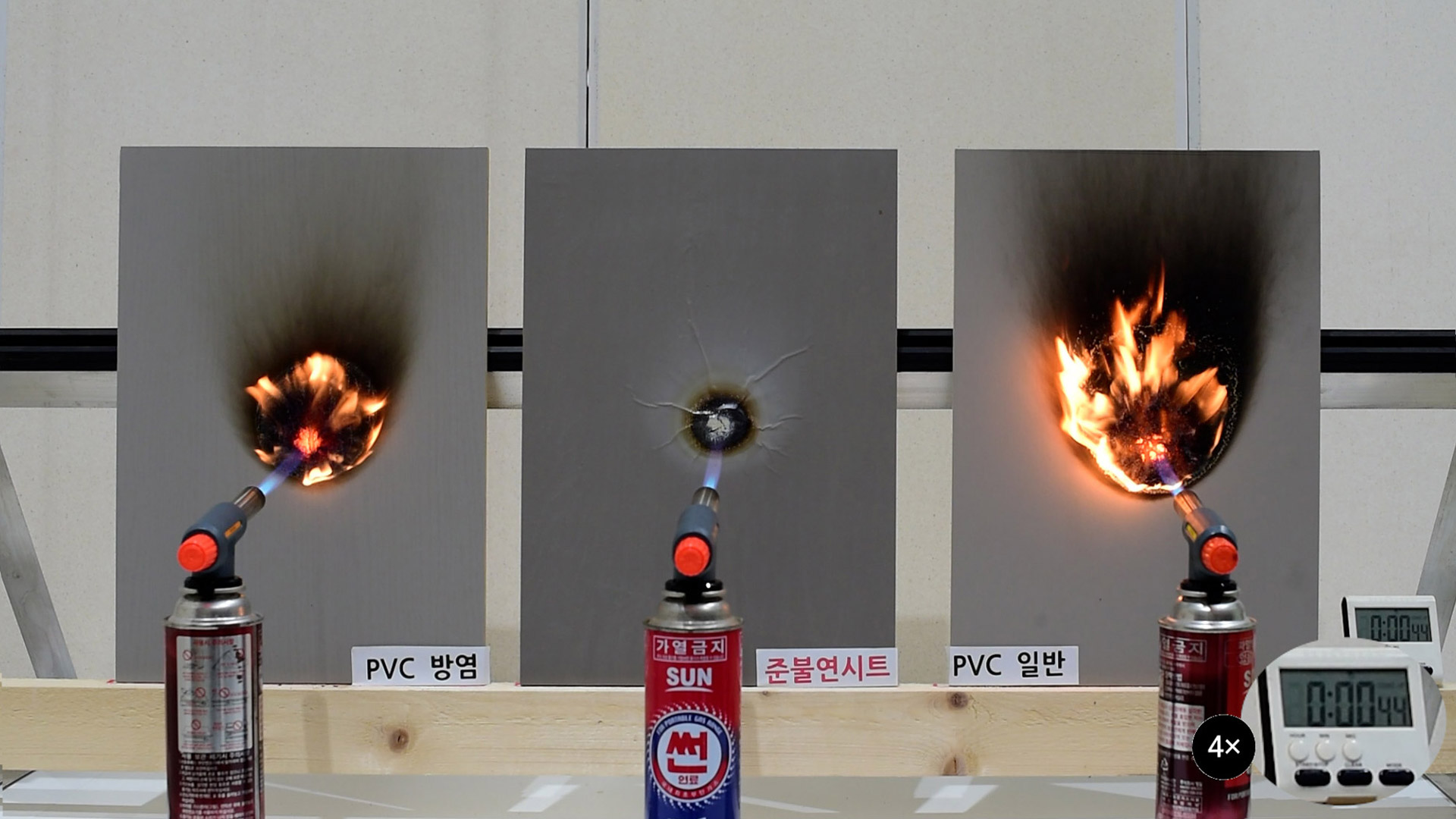
A side-by-side torch test of interior finishes. Reaction-to-fire behaviour is exactly what classes like Class A and B-s1,d0 are built to grade. Test-video still.
The UK/EU system: EN 13501-1 Euroclass
Across the UK and Europe, the equivalent framework is EN 13501-1, which assigns a "Euroclass" for reaction to fire. It's more granular than the US letters. The main classes run A1, A2, B, C, D, E, F (A1 being the most limited contribution to fire), and each is paired with two sub-ratings: a smoke class (s1, s2, s3) and a flaming-droplets class (d0, d1, d2). So a rating like B-s1,d0 reads as: class B (limited contribution to fire), lowest smoke production (s1), no flaming droplets (d0).
In England, the guidance that maps those classes to real buildings is Approved Document B, the fire-safety document supporting the Building Regulations (Approved Document B, gov.uk). It sets where given Euroclasses are acceptable for wall and ceiling linings, with tighter requirements on escape routes and taller buildings.
Why the class actually matters: Grenfell, read carefully
The reason reaction-to-fire classification is treated so seriously in the UK today has a name: Grenfell Tower. On 14 June 2017, a fire in the West London tower block killed 72 people. The Grenfell Tower Inquiry found that combustible aluminium composite material (ACM) cladding was the primary reason the fire spread up the building the way it did (Grenfell Tower Inquiry).
Now the caveat, and it isn't optional. Grenfell was about external façade cladding and insulation (the combustible skin on the outside of the building), not interior wall or ceiling film. It is not a like-for-like example of an interior finish, and it shouldn't be sold as one. Cite it for the principle, not the analogy: it is the clearest modern demonstration of why the reaction-to-fire class of a building material is a life-safety decision rather than paperwork. When a combustible material ends up where it shouldn't, the class on the datasheet stops being academic.
That principle carries straight back to interior finishes, which is where it belongs in this discussion.
Where YEILDECO's film fits
YEILDECO distributes a PVC-free interior/architectural film that holds a quasi-non-combustible certificate from Korea's KFI. That's a Korean classification.
Be clear about what that does and doesn't say for a US or UK spec. It does not mean the product holds a US ASTM E84 class or an EN 13501-1 Euroclass. It doesn't, and we won't claim it does. Those are separate national test regimes. What we can do is treat ASTM E84 Class A or EN 13501 B-s1,d0 as testable and classifiable on request: if your project needs a local rating documented, that's a testing conversation to open up front, not a box we tick for you on a web page.
The definition still matters here: quasi-non-combustible is not non-combustible and not "fireproof." What the certificate does is hold heat release under a strict legal limit, slowing fire spread and preserving evacuation time, which is exactly why regulations target escape-critical spaces.
If you're specifying finishes for a school, healthcare, or hospitality project and want to line up the certification and the testing route for your market, start on the YEILDECO product page, or see where this film is actually installed in Korea, which is mostly schools and care facilities for exactly the reasons above.
YEILDECO
Fire-rated, PVC-free architectural film
Semi-non-combustible (KFI-certified), PVC-free interior film from Korea. We welcome distributor and export inquiries.