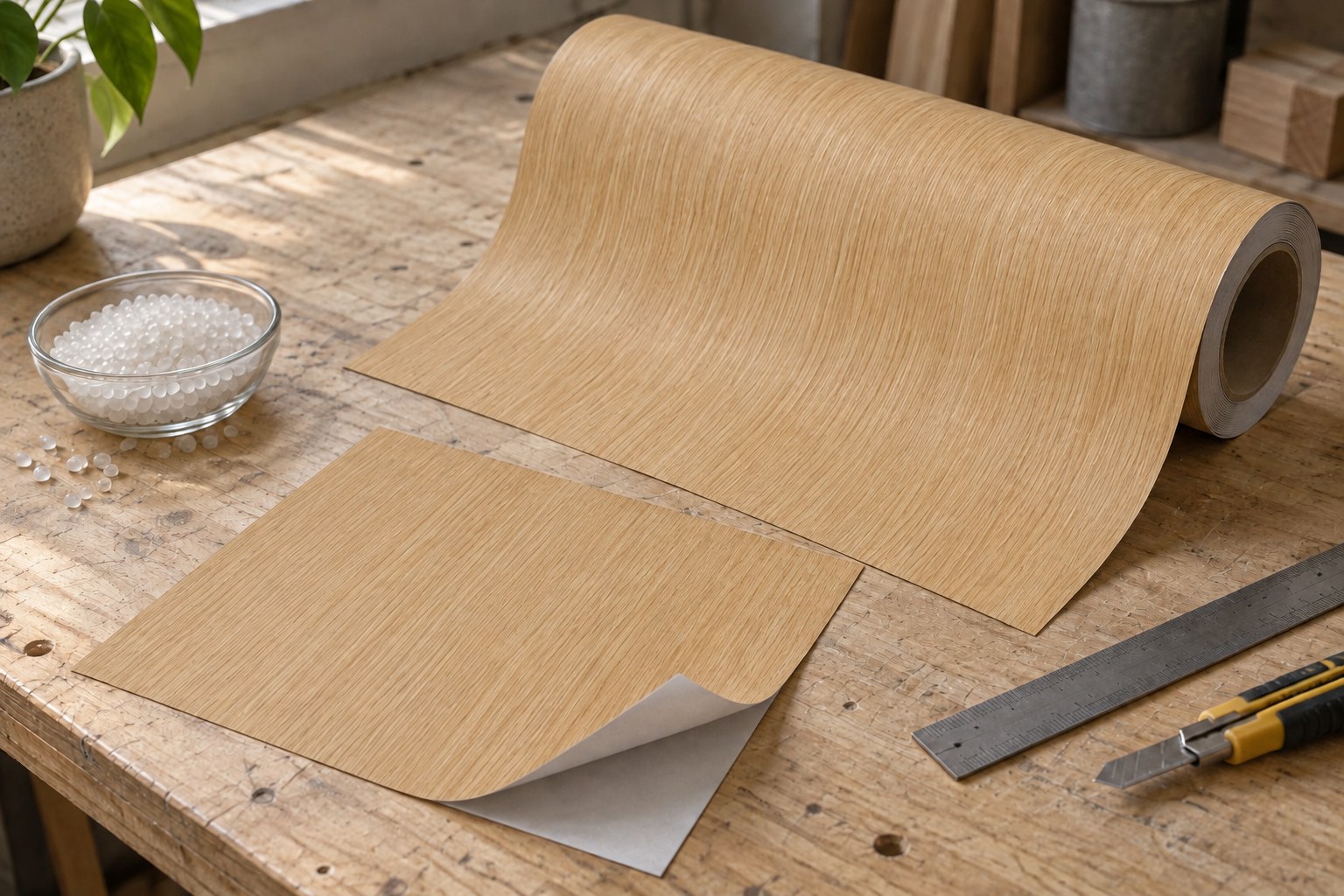
Staged visualization. Colour: AW005 (wood colour range)
Ask a fire investigator what actually kills people indoors and you'll rarely hear "the flames." Walk a burned-out unit and the structure is often still standing. The occupants didn't burn to death. Many stopped breathing long before the fire reached them.
This isn't a new finding. Both the U.S. Fire Administration and the NFPA have long framed smoke and toxic-gas inhalation as the leading cause of death in building fires, ahead of burns. The numbers hold it up. In the USFA's Topical Fire Report on U.S. residential building fires from 2017 to 2019, smoke inhalation alone accounted for about 35% of civilian deaths, and smoke inhalation combined with burns for roughly 49% (USFA, U.S. residential building fires 2017–2019). Read that twice: close to half of the deaths involved being poisoned by the air.
The pattern crosses borders. In England, Home Office fire statistics for 2021/22 recorded "overcome by gas or smoke" as the single largest cause of fire death at 32%, ahead of burns at 31%, and asphyxiation has led that table almost every year since 2009. Korea's data points the same way: in apartment-building fires, 77.9% of deaths were related to smoke and toxic gas (Korea Fire Safety Institute, national fire data 2014–2018, apartment housing).
For anyone who specifies interior finishes (architects, importers, fit-out contractors), that reframes the job. If the smoke is what does the damage, then the smoke your wall and ceiling materials give off is a design decision, not a footnote.
The finish on the wall is often the fuel
A room fire needs fuel, and modern interiors supply plenty of it. Furnishings, adhesives, and surface finishes all feed a fire once it takes hold. Wall and ceiling coverings matter more than their thinness suggests, because they line the exact surfaces flame and smoke travel across. A finish that ignites easily, carries flame, and pours out dense smoke can turn a contained fire into a survivable-space problem in minutes.
That's the practical reason reaction-to-fire ratings exist for interior finishes at all. It's also the reason what a finish is made of is worth asking about before you spec it.
PVC burns into an acid gas
Here's the part that gets skipped in product brochures. Polyvinyl chloride (PVC, vinyl) is roughly half chlorine by weight. Burn it and that chlorine doesn't vanish. NIST's literature assessment of PVC pyrolysis and combustion products identifies hydrogen chloride (HCl) as a principal toxic product when PVC decomposes (NIST, PVC combustion products literature assessment). HCl is corrosive; inhaled, it attacks the airway. It also cuts visibility and drives panic. The same smoke that's poisoning people is hiding the exit from them.
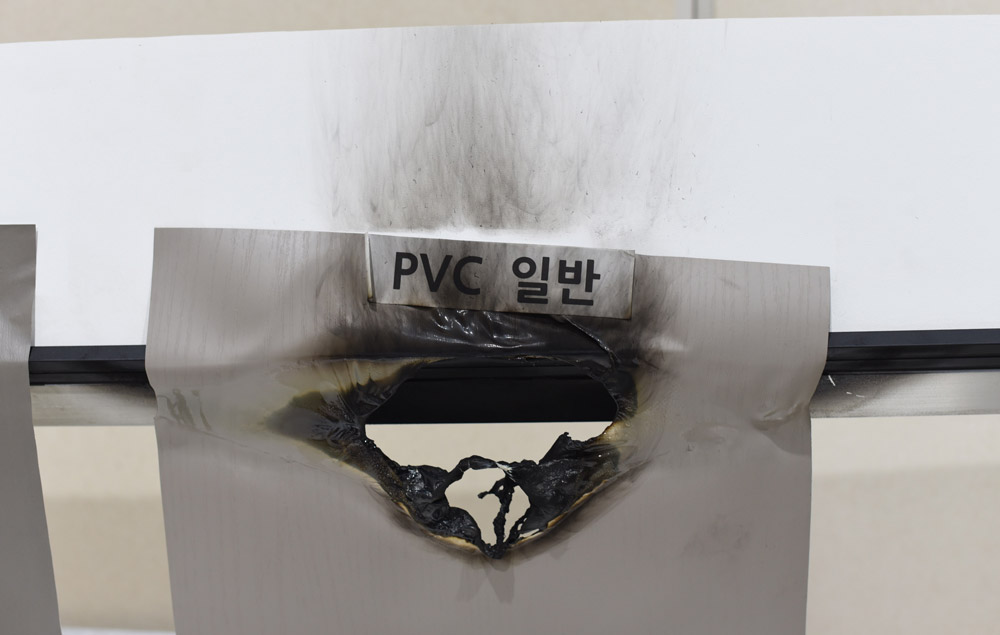
A PVC sample after a torch test: it chars, blisters, and gives off smoke. Test-video still.
So a PVC finish can meet a burn-resistance grade on paper and still be a chlorine reservoir. Passing a flame-spread class tells you how fast fire crosses the surface. It doesn't tell you what the surface exhales while it does.
The dioxin question: real, but conditional
You'll sometimes hear that burning PVC "produces dioxins." Be precise here, because the science is. Dioxins can form when chlorine-containing material burns under certain conditions: incomplete combustion, particular temperature ranges, available catalysts. A peer-reviewed review of PVC combustion in Waste Management & Research treats dioxin formation as condition-dependent, not guaranteed (Zhang & Buekens, 2015). The honest phrasing is "can, under some conditions," never "always." What isn't conditional is the HCl.
What PVC-free actually removes
The cleanest way to not release hydrogen chloride from a finish is to not put chlorine in the finish. That's the whole idea behind PVC-free film.
Among the PVC-free interior/architectural films YEILDECO distributes, Neotec SAVE is built on a PP/PET base with a metal fire-safety layer, and no PVC. The renewed Hansol Art-Eco line shares the same construction. No chlorine in the polymer means there's no chlorine to convert into HCl at the source when fire reaches it. Both lines are certified quasi-non-combustible by Korea's KFI.
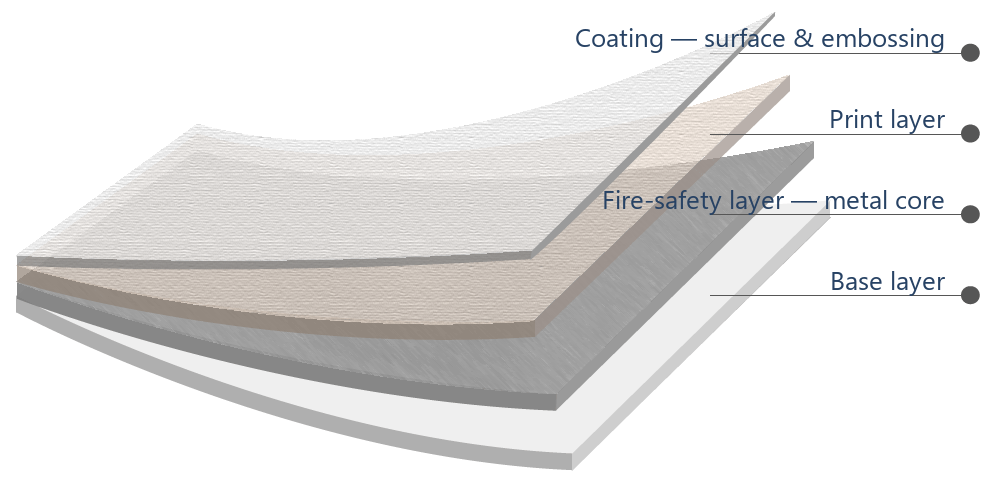
The layer structure: a PP/PET base with a metal fire-safety layer, no PVC.
Two points of context belong here. First, the certification and the test report are issued in the manufacturer's name and verified by KFI, Korea's official fire certification body, so every number here is third-party checkable rather than our own marketing claim; as the official distributor we publish the scans in full. Second, and this one matters: quasi-non-combustible is not the same as non-combustible, and it is not "fireproof." It does not mean the material won't burn. It means the material meets a defined limit on heat release under a standardized test: a meaningful bar, not a magic one. Anyone who tells you a finish "won't burn" is selling, not specifying.
The takeaway for specifiers
Design for the smoke, not just the flame. Ask what a finish is made of, not only what class it passed. If a material is going to end up on the walls and ceilings of a school, a hospital, or a hotel corridor (the places where people need time and clear air to get out), the chemistry of what it releases under fire is a fair question to put to your supplier. Those are, not coincidentally, the buildings where this film actually gets installed.
See the material and its certification on the YEILDECO product page.
YEILDECO
Fire-rated, PVC-free architectural film
Semi-non-combustible (KFI-certified), PVC-free interior film from Korea. We welcome distributor and export inquiries.