A question we rarely saw a decade ago now shows up in export tenders: is the film phthalate-free? For interior finishes headed to the EU, or screened by EU-facing procurement teams, it sits close to the fire rating in priority. If you sell, specify, or import architectural film, this one is worth understanding at the material level, because that's where it gets decided.
Why phthalates keep coming up in export tenders
REACH restricts four phthalate plasticizers (DEHP, BBP, DBP, DIBP) above 0.1% in plasticized material across the EU. Because most PVC decorative film is softened with plasticizers, buyers now screen for them. A PVC-free PP/PET architectural film uses no plasticizer at all, so the question doesn't apply.
Buyers asking this aren't chemists. They're managing compliance risk. A rejected shipment or a substance declaration that can't be signed is expensive and slow, so procurement pushes the question upstream to the material and asks it early. That instinct is correct. By the time a finish is on the wall, the chemistry was already fixed when the film was made, and no amount of paperwork changes what the polymer contains.
The pattern holds across our export markets. German assembly-venue and healthcare projects, UK fit-outs working to Approved Document B, North American interiors: different fire vocabularies, same procurement habit of screening the substances first. Once a class of chemical is on a regulator's list, buyers tend to treat the whole category as something to document, whether or not a specific product still uses it.
What REACH actually restricts
REACH is the EU's chemicals regulation. Annex XVII, entry 51, restricts four phthalates (DEHP, BBP, DBP, DIBP) above 0.1% by weight in plasticized material, in force since 7 July 2020 (ECHA). Those four are among the plasticizers historically used to soften PVC. The United States runs a parallel track under a different law: through CPSIA section 108, the Consumer Product Safety Commission permanently banned eight phthalates in children's toys and childcare articles (2017 final rule, CPSC).
Now the honest part, because overselling this would be a mistake. REACH restricts specific named phthalates above a threshold. It does not ban PVC, and it does not mean every vinyl film on the market contains a restricted substance. Many manufacturers reformulated years ago with non-phthalate plasticizers to stay compliant, and a PVC film built that way can be fully REACH-compliant. For a buyer, legality isn't really the issue. The compliance question simply exists, and someone has to answer it for every batch, in writing, whenever the spec crosses into a regulated market.
Why PVC decorative films usually carry plasticizers
Here's the material reason the question attaches to vinyl specifically. PVC comes in two families. Rigid PVC (pipe, window frames) uses no plasticizer and stays hard. Flexible PVC is softened with plasticizers so it can bend and wrap around a curve without cracking. Interior decorative film has to do exactly that at a fraction of a millimetre thick, so it is generally flexible PVC, and flexible PVC has historically meant phthalate plasticizers such as DEHP. The softness that makes a vinyl film easy to apply is the same property that puts a plasticizer in the formula in the first place.
Those plasticizers don't stay locked in the polymer forever. Phthalates are semi-volatile compounds, so over a material's service life they can migrate out into indoor dust and air. This is the health thread running underneath the regulation. A 2008 meta-analysis (Jaakkola & Knight, Environmental Health Perspectives) found PVC surface materials and phthalate exposure associated with childhood asthma (odds ratio 1.55, 95% CI 1.18–2.05) and allergic rhinitis (OR 1.32, 95% CI 1.09–1.60) (PMC2453150). Read that carefully. These are observational odds ratios describing an association, not proof that the material causes the condition, and an odds ratio is not the same as saying risk rises by a set percentage. Regulators, though, don't wait for causation to be settled before restricting a substance, and neither do cautious specifiers. The restriction itself is the clearest signal of where official concern sits.
How a PP/PET film sidesteps the question

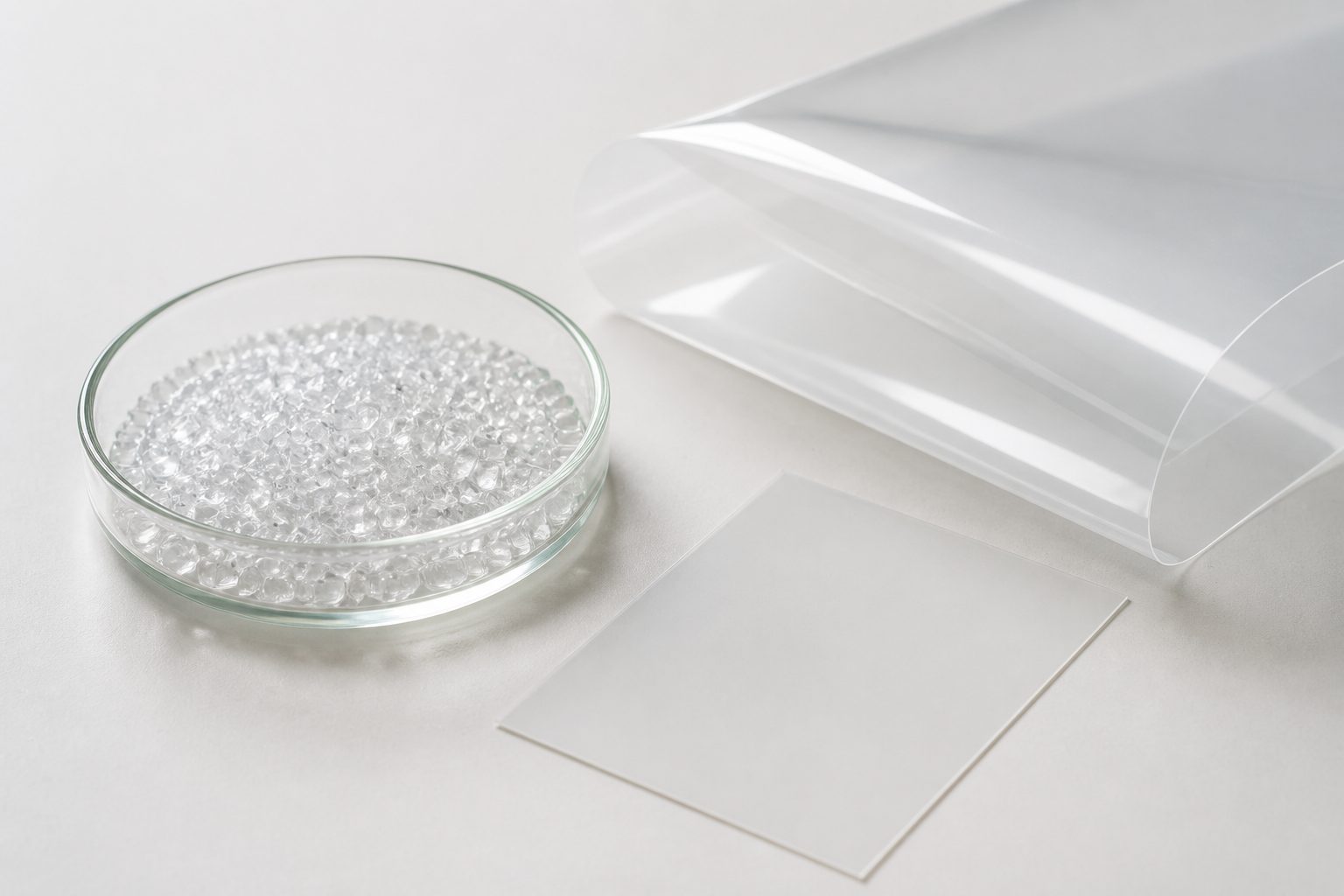
The film we distribute is built on a PP/PET base rather than vinyl. PP and PET stay workable without plasticizer, which is why the same polymer families are used across food packaging. No plasticizer means no DEHP, no DBP, nothing on the REACH entry-51 list in the base material. With a PP/PET film the phthalate question doesn't get a cleaner answer: it stops being a question you have to answer at all.
A second consequence comes free with the chemistry. There is no chlorine in the polymer, so the film produces no hydrogen chloride when it burns, unlike PVC, which is a large fraction chlorine by weight. We covered the smoke-inhalation side of that in detail in a separate post on why smoke, not flame, is usually what kills.
One honest limit, because we won't get out over our skis on this. We don't have a published head-to-head lab comparison of PP/PET against PVC decorative film on a standardized toxicity test, and we won't invent a percentage to fill that gap. The defensible claim is narrow and chemical: no plasticizer means nothing from the REACH phthalate list to declare, and no chlorine means no HCl precursor when the material burns. That's the whole claim, and for most specifiers it's enough.
Fire rating, kept straight
Because this is a fire-rated product, the phthalate story and the fire story have to stay in their own lanes. Our film holds a quasi-non-combustible certificate (준불연, KS F ISO 5660-1) issued by Korea's KFI. Quasi-non-combustible is not non-combustible and not "fireproof." The material can still burn; the certificate bounds how much heat it contributes under a defined cone-calorimeter test.
For EU projects, the reference class people ask about is Euroclass B-s1,d0 (EN 13501-1). The Korean cone-calorimeter method and the European SBI test aren't the same procedure, though, so we describe the film as corresponding to that performance band rather than claiming the Euroclass. We do not hold EN 13501-1. Where a project needs the local classification documented, that's a testing route we arrange on request, not a badge we print on a web page.
What to ask before you commit

If you're specifying or importing, put the phthalate question in writing and make the supplier answer at the material level rather than with a reassuring adjective. What is the film actually made of, and is there a substance declaration that covers the REACH entry-51 phthalates? A reformulated PVC film can answer both cleanly. A PP/PET film answers them because those substances were never in it to begin with. While you're there, ask what the film puts into the air when it burns, a related question with the same root cause in chlorine and plasticizer.
For schools, healthcare, and other buildings where children and vulnerable occupants spend long hours indoors, the material-level answer is worth a line on the spec sheet rather than a footnote. Start with the product overview, or write to us for the substance and fire documentation for your market.
YEILDECO
Fire-rated, PVC-free architectural film
Semi-non-combustible (KFI-certified), PVC-free interior film from Korea. We welcome distributor and export inquiries.