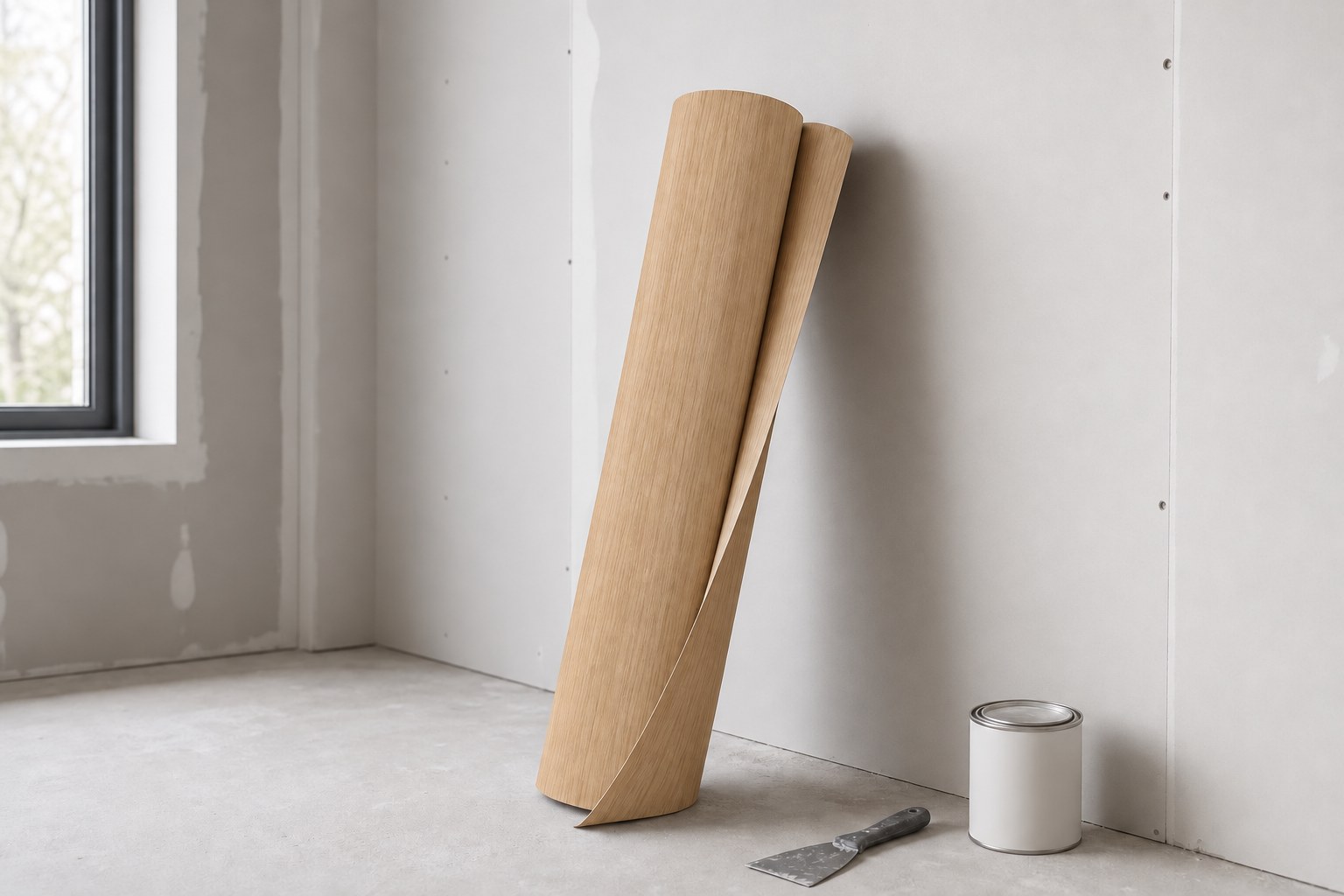
Staged image. Colour: AW005 (wood colour range)
In consultations, the most frequent question after colour is "Will it go on our wall?" The answer lies in the surface underneath, the substrate. A large share of film defects come from the substrate rather than from the film itself, so the substrate is the first thing we check, before any order.
Substrates that work: smooth, dry and dust-free
These are the standard substrates for film:
- Gypsum board (plasterboard): the most common substrate. With the joints filled with putty and a coat of primer on top, it gives a stable face.
- Plywood, MDF and other wood-based boards: the standard base for refacing furniture and doors. Dust removal and primer come first.
- Steel and other metal surfaces: elevator doors, fire doors, partitions. Degreasing decides the result.
- Existing paint or film: if the old layer is firmly bonded with no lifting, film can go over it after surface preparation. A coating that is peeling away cannot carry film.
All four share three conditions: smooth, dry, and free of dust and oil. If any one of them fails, adhesion drops, and the failure shows up later as lifting or peeling.
Substrates that need care
- Cement and concrete render: unsuitable as it stands. Surface dust (laitance) and unevenness leave the bond unstable. The face needs putty to level it, then primer, and on new render the installer also checks that the moisture has dried out before applying film.
- Over wallpaper: paper wallpaper cannot hold the film's tension. The rule is to strip it, form a sound face, then apply.
- Glass and deeply profiled mouldings: glass is the territory of products made for glass. Deep mouldings take a separate technique, because the film's restoring force works against deep contours; our moulding guide covers the options.
For a substrate that is hard to judge, a photo is the fastest route. If you send one through the inquiry form, we will tell you from the site conditions whether film will work there and what preparation it needs.
Preparation sequence
On our technical data sheet, the first two installation steps, priming and drying, are substrate work. With the groundwork that comes before them, the sequence runs:
- Groundwork: dust and oil removed, unevenness filled with putty to a smooth face.
- Water-based primer, then complete drying: with any film, primer that is still damp when the film goes over it leaves moisture behind, and that moisture causes lifting. A film with a dense, high-density resin surface lets little of that moisture escape, so for these films ample drying time is the standard procedure.
- Application: pressing, corner work and a room temperature held at 18–24°C follow from there.
The fire-rating view: a rated substrate keeps the build-up consistent
On projects that call for a quasi-non-combustible finish, the substrate comes under review along with the film. Quasi-non-combustible film over a substrate of quasi-non-combustible grade or higher, such as gypsum board, is the consistent build-up for fire performance, and it is the standard combination in practice.
One feature of the current certified lines we supply, Neotec SAVE and the renewed Art-Eco line: their KFI certification covers the material itself, the film, rather than a film-and-substrate combination. Japan's ministerial approval, by contrast, attaches to a combination of film and designated substrate; Inside a Korean KFI fire test report explains the difference. The documents an authority asks for can still vary by project and jurisdiction, so on a rated project we go through the paperwork with you before the order. The original scans are in our certificates section, and if your authority works with another classification system, our standards comparison maps the Korean grade against it.
Verdict and preparation for each substrate
| Substrate | Verdict | Condition |
|---|---|---|
| Gypsum board, plywood, MDF | Suitable | Putty, primer, full drying |
| Steel, metal | Suitable | Degreasing |
| Existing paint or film | Conditional | Firmly bonded with no lifting, surface prepared |
| Cement or concrete render | Conditional | Putty to form the face, dryness confirmed |
| Paper wallpaper, glass | Unsuitable / separate category | Strip first / products made for glass |
Substrate questions and project enquiries go through our inquiry form. Colours are on the products page, and we recommend seeing a physical swatch before you specify.
YEILDECO
Fire-rated, PVC-free architectural film
Semi-non-combustible (KFI-certified), PVC-free interior film from Korea. We welcome distributor and export inquiries.