Installation record photo, not a staged image. Installed by YEILDECO; photograph from the D-Guard project gallery.
Most of the images on this site that show film in a room are staged visualizations, and we label them as such. This one is different. What follows is the record of a YEILDECO installation at an elementary school in Korea: eighteen photographs taken during and after a remodel, with the material noted per photo. We are showing six of them, chosen because each answers a question a buyer or a specifier tends to ask.
Why a school, and why film
Korean building rules treat corridors and stairs as escape routes. Their walls and ceilings must be finished with at least quasi-non-combustible material in every building, whatever its use. Schools also belong to the occupancies that the enforcement decree lists for finish-grade requirements. The practical consequence for a remodel is that the pretty part of the job, the colour, has to arrive with paperwork: a certificate in the manufacturer's name and a test report behind it. How that certificate reads is covered in Inside a Korean KFI fire test report, and the scans themselves are in our certificates section.
The record lists two products: Hansol Art-Eco quasi-non-combustible sheet, in several pastel solid decors, and Neotec SAVE, in a wood decor. Both are self-adhesive films applied on site over the existing substrate, so most of the work is surface preparation and wrapping rather than demolition.
Classroom storage wall
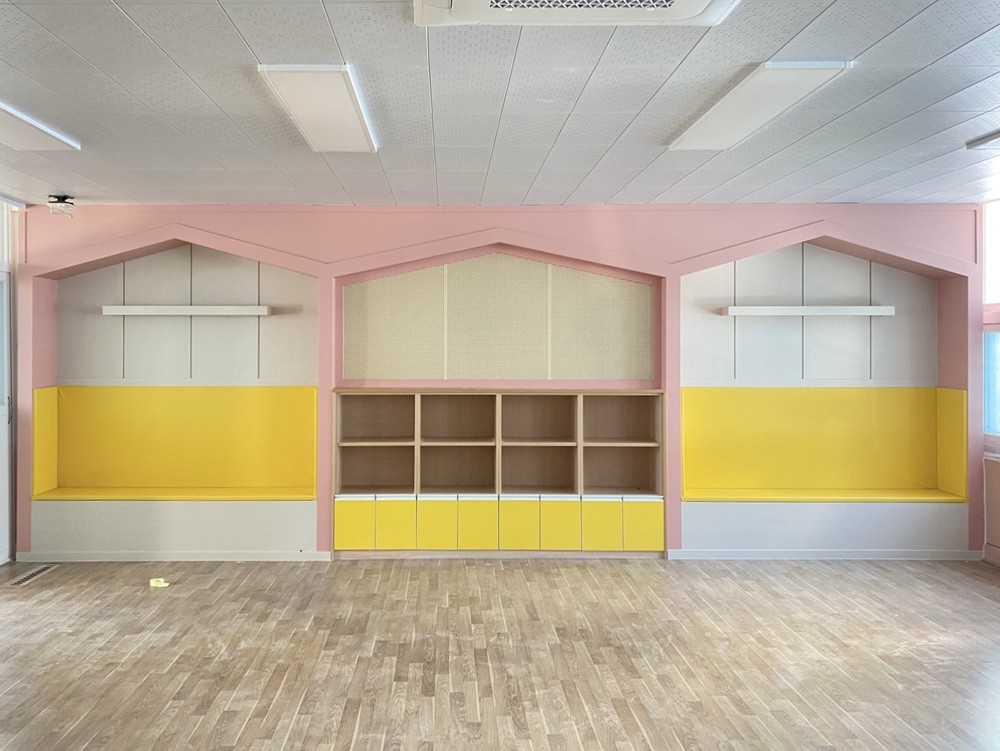
The back wall of a classroom: a gabled pink surround, white bays with a single shelf, yellow bases and yellow cabinet doors under the open shelving. The flat panels are film over the existing board; the open shelves keep their wood finish.
This is the typical school brief: a large flat wall that children touch every day, in a colour the teachers chose, on a surface that has to carry a finish grade. The film gives the wall one continuous colour with no visible joints at eye level.
Corridor openings and wainscots
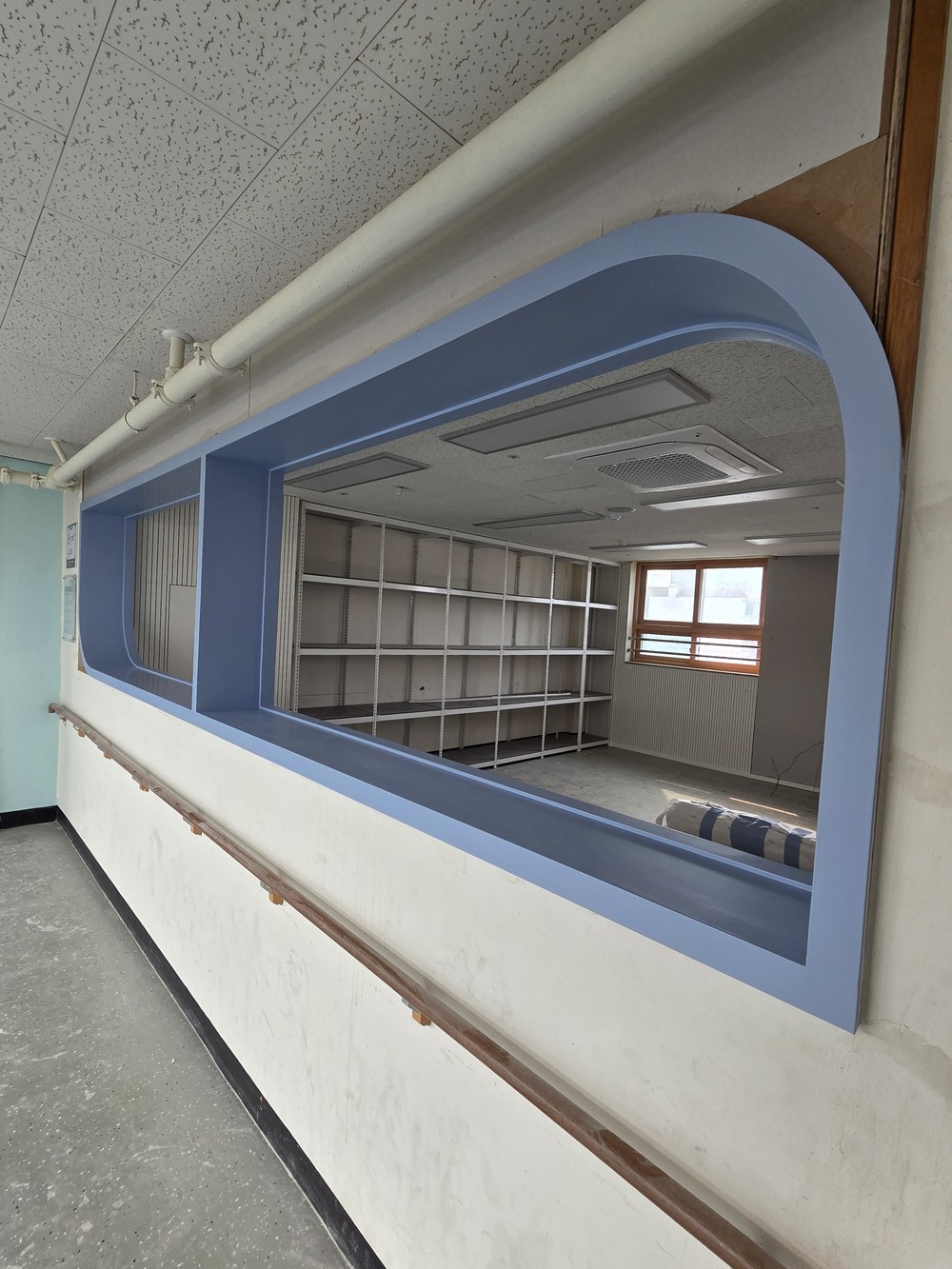
From the corridor: a rounded interior window into a room being fitted out. The deep reveal of the opening is wrapped in blue film; the wooden handrail and the lower wall were left as they were.
Corridors are where the escape-route rule applies most directly. Here the film went onto the reveals of the openings, the surfaces that bags and shoulders scuff, while the painted wall itself was left alone.
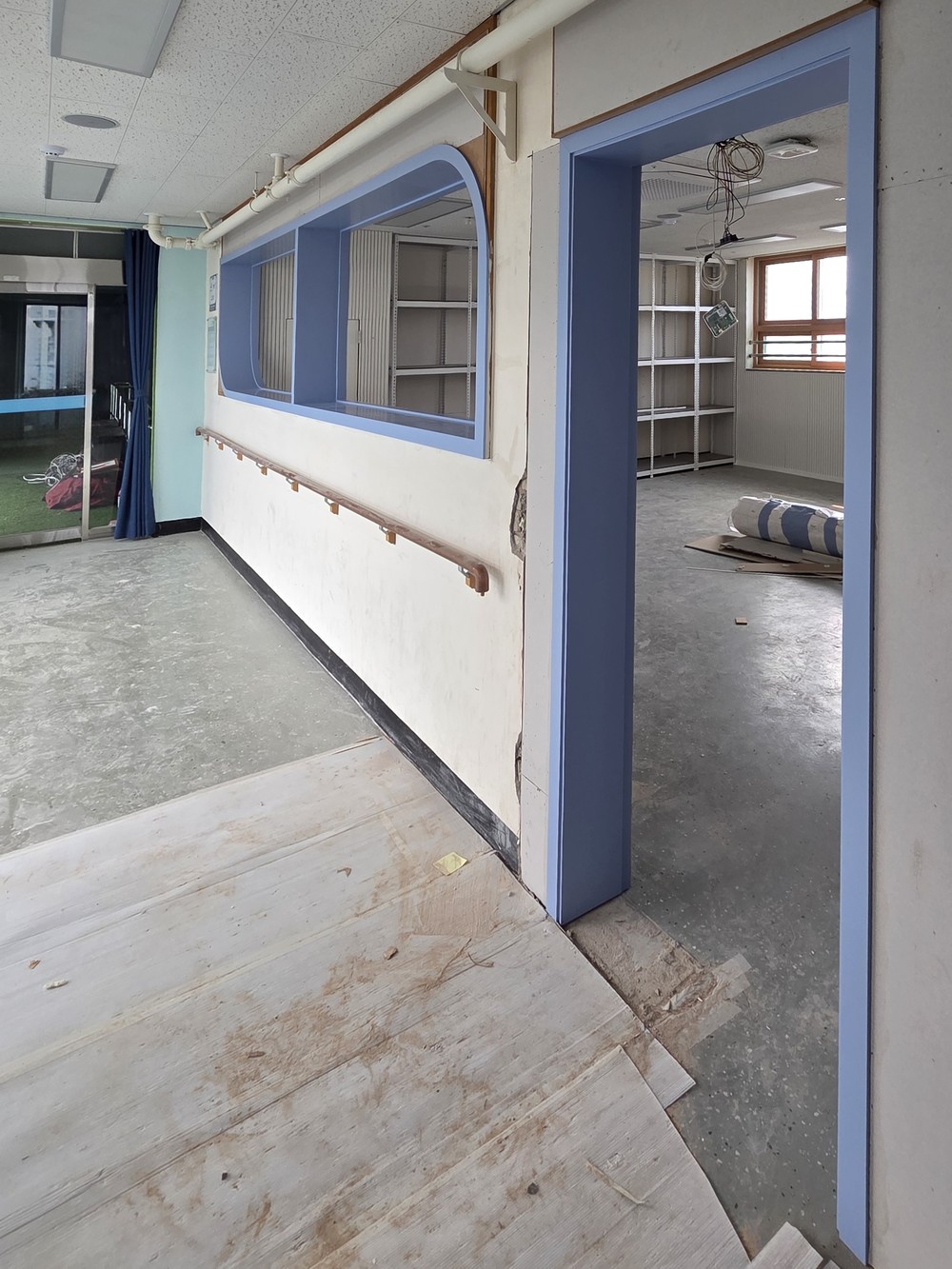
Mid-project. The interior window and the door opening are already framed in blue film; the corridor floor is still bare board over concrete, and the room beyond holds temporary shelving. Frames are wrapped before the floor finish goes down, which then covers the bottom edge of the film.
Doors and frames
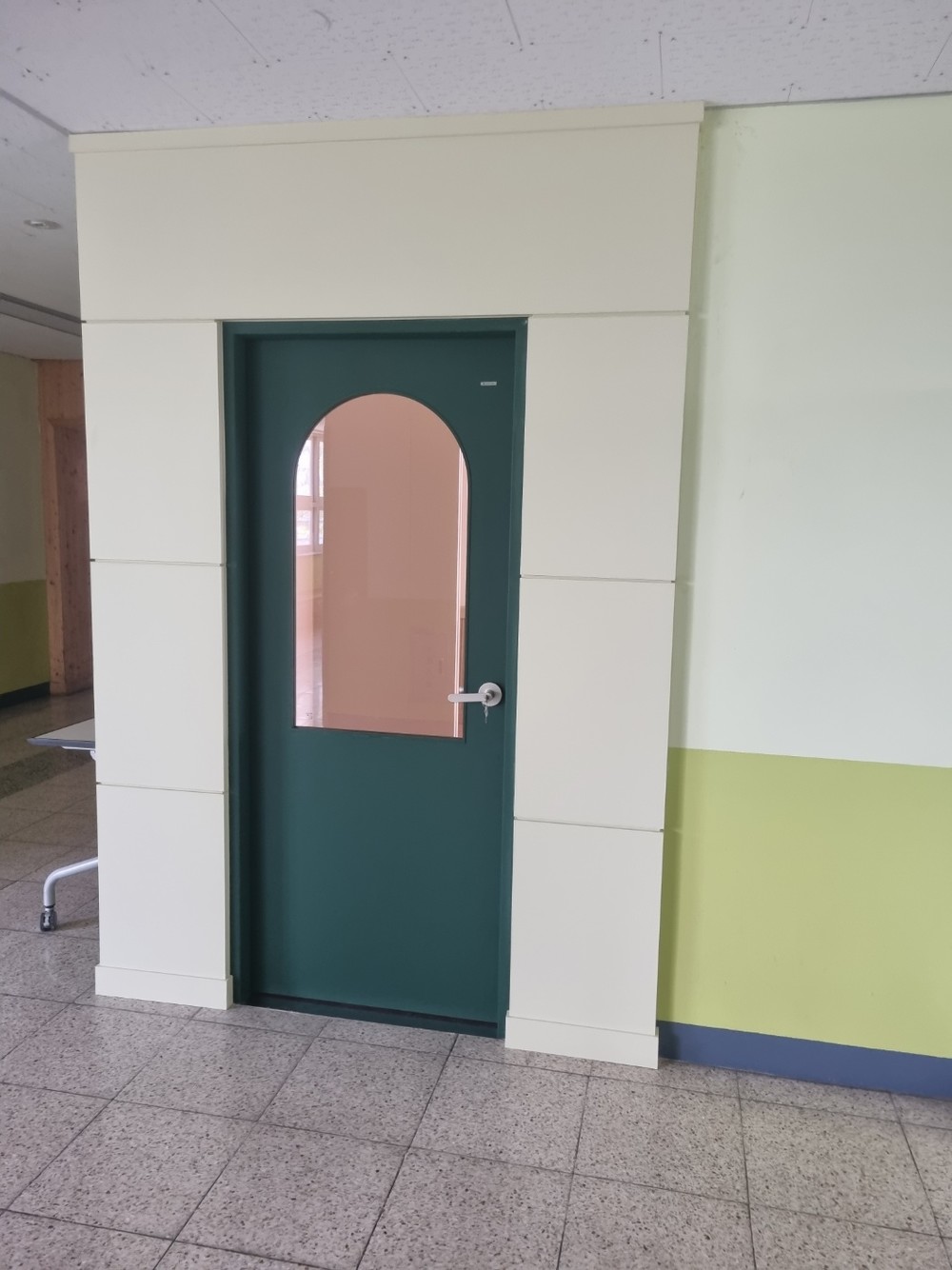
A classroom door with an arched vision panel. The leaf is wrapped in dark green, the surround in cream panels, and the wall beside it carries a green wainscot band. All of it was applied in place on the existing door and frame.
Wrapping an existing door on site, instead of ordering a new leaf, is the single most common way this film enters a public building. The same technique is described for residential doors in Entrance door refacing with fire-rated film.
Built-in cabinets under the windows
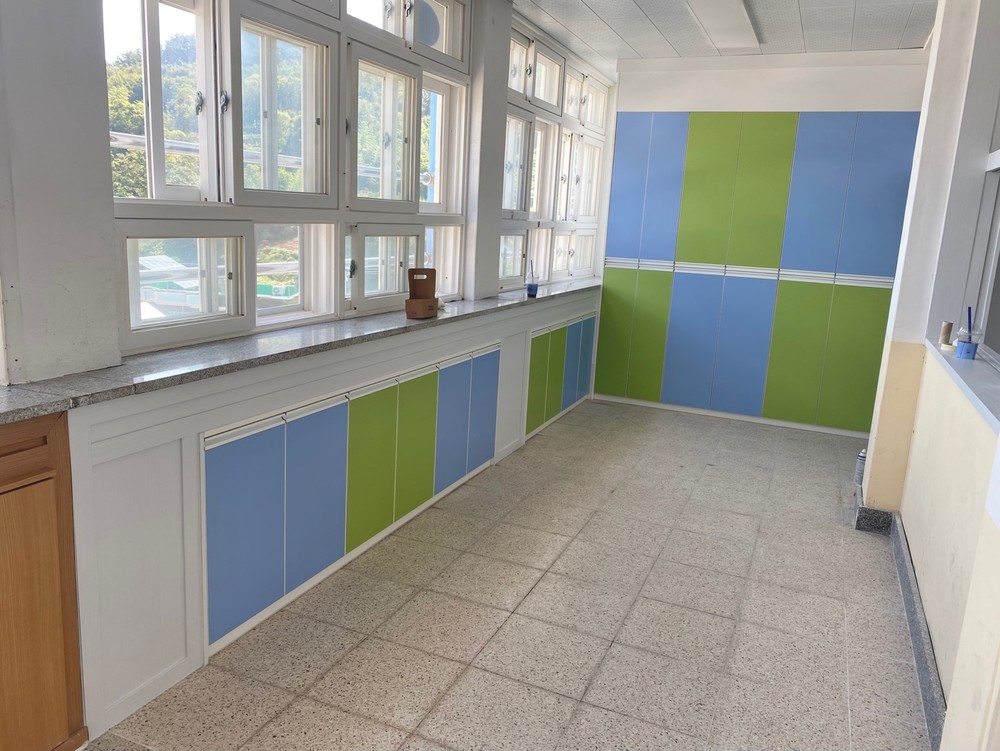
Cabinet fronts under the window sill in alternating blue and green, and a tall cabinet wall at the end of the room in the same two colours. The carcasses are the originals; only the fronts changed colour.
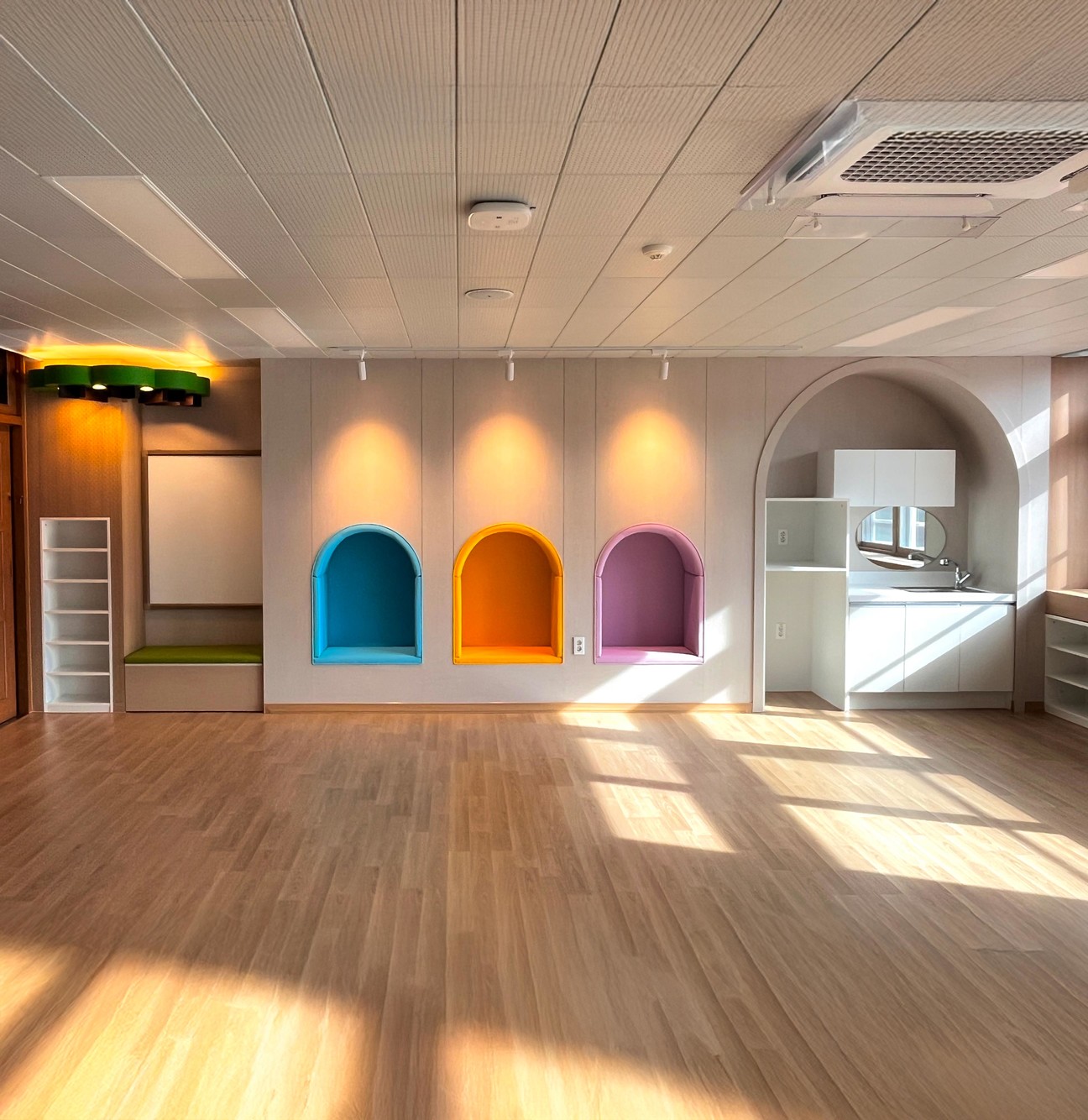
Reading nooks lined in blue, orange and purple, beside an arched doorway to a small kitchenette. Curved reveals like these are wrapped with heat, one arch at a time.
What the record shows a buyer
Three things, and none of them is a marketing claim.
- The substrate stayed. Frames, reveals, cabinet fronts and door leaves were finished in place rather than replaced, and the school kept its floor plan.
- The colour range is real. Pastel solids from the Art-Eco range and a wood decor from Neotec SAVE were combined in one building. The current colours are on the Art-Eco product page and the Neotec SAVE product page.
- The paperwork exists. The certificate is issued to the manufacturer, which is normal in Korea, and we explain what that means for an importer in What to check when importing fire-rated film.
The full set of installation records, fifty-two sites including hospitals, a postnatal care centre, offices and apartment buildings, is in the projects section. If your market has a school, clinic or public building on the table, tell us the building type and the finish grade your authority asks for, and we will send the documents that apply. Distributor enquiries go to the same contact section.
Installation: YEILDECO. Photographs: D-Guard project gallery, Korea. Product names as recorded per photo.
YEILDECO
Fire-rated, PVC-free architectural film
Semi-non-combustible (KFI-certified), PVC-free interior film from Korea. We welcome distributor and export inquiries.