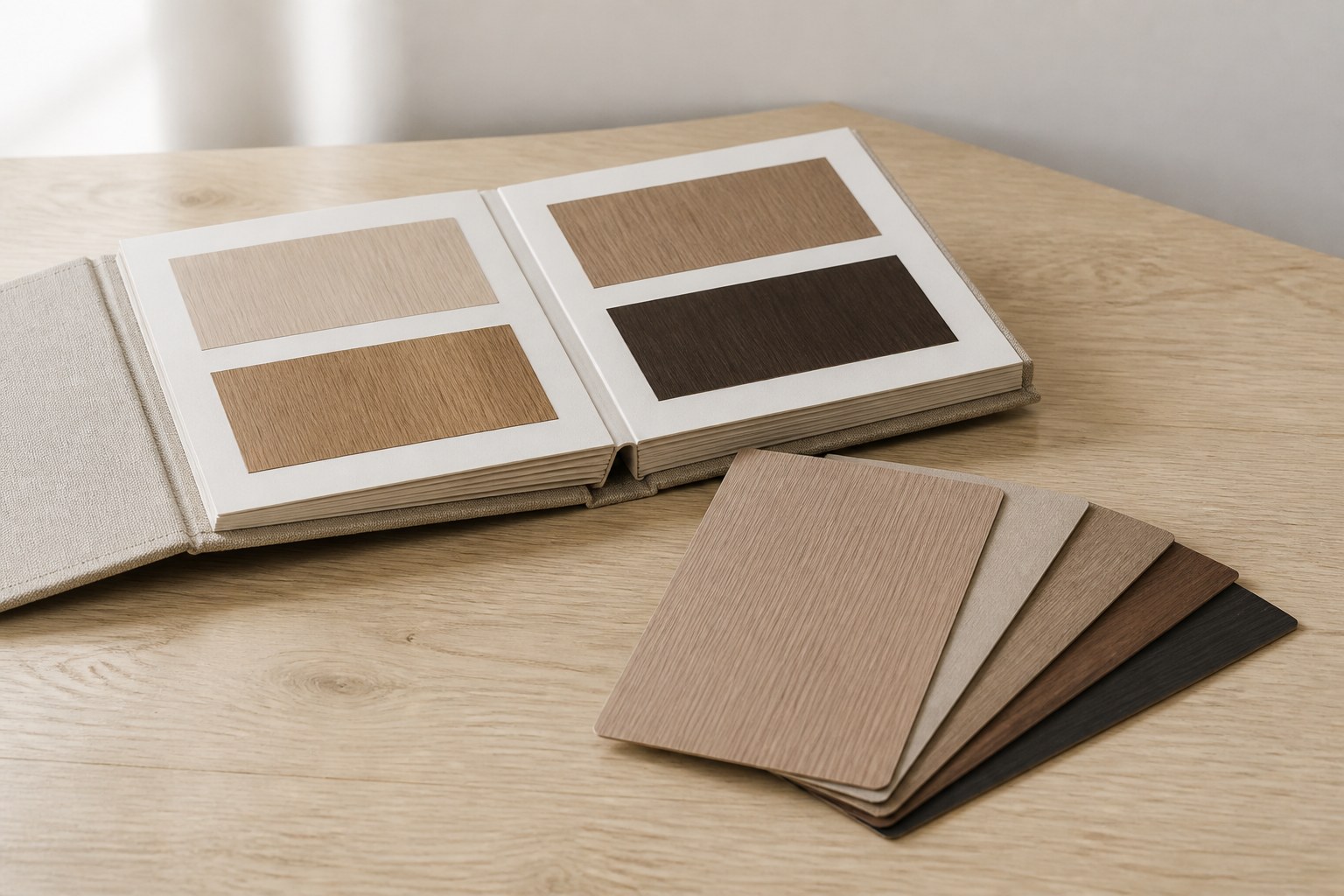
Staged visualization. The swatch reproduces our actual colour AW005M.
We spent the first week of August at the Building Fire Safety Industry Expo in Seoul (booth B-814, alongside Korea Build Week), and the questions from international visitors were remarkably consistent. Not "is the film good", but "what paper proves it, and what do I check on that paper?"
Fair question. Fire performance is exactly the kind of claim that should survive a document review. So here is the checklist we would apply to our own product if we were the buyer, in the order we would work through it.
1. The fire certificate, with names checked
Ask for the KFI quasi-non-combustible certificate itself, not a brochure statement about it. Then check two details that trip people up:
- The certificate holder. Korean fire certificates are often issued to the manufacturing plant rather than the consumer-facing brand. That is normal, but the supplier should be able to explain the relationship in writing. For the SAVE film we distribute, the certificate is registered under certification number 내장26-5 (issued 30 June 2026 in the manufacturer's name), and we walk buyers through the naming on request.
- The tested build-up. A certificate applies to what was actually tested. Ask what substrate the specimen used and confirm your intended application matches. A one-line answer here saves an argument with your local authority later.
2. The test report, with real numbers
A pass mark alone tells you little. The report behind a Korean quasi-non-combustible grade contains measured values against two gates:
- Heat release (KS F ISO 5660-1, cone calorimeter): total heat release within 10 minutes must stay at or under 8 MJ/m², and the heat release rate may not exceed 200 kW/m² for more than 10 consecutive seconds.
- Gas toxicity (KS F 2271): exposed laboratory mice must keep an average behaviour-stop time of 9 minutes or longer.
We published our own measured values, with the reading order, in Inside a Korean KFI fire test report, and the toxicity gate has its own explainer in The nine-minute test. A supplier who hesitates to show measured values is asking you to buy the label, not the performance.
3. A mapping to your market's system
A Korean certificate does not slot directly into a US or EU spec sheet. The honest framing is comparable level, not the same paper: the Korean system measures heat release, ASTM E84 measures flame spread, and Euroclass has its own ladder. What we tell North American buyers, including the conversation to have with your AHJ, is in our Class A equivalence guide. Ask any supplier for the same mapping to your market, and be suspicious of one who claims the certificates are simply interchangeable.
4. Composition and chemical compliance
If PVC-free matters to your market (and in the EU it increasingly does), ask for it in writing: base polymer, plasticizer position, and the REACH or phthalate statements your customs and customers will want. Our SAVE film is a PP base with a metal fire-safety layer and no chlorine in the polymer, and we covered the paperwork side in PVC-free film and REACH.
5. Samples you can put in front of a client
Digital sample books and a technical data sheet are the fast first step; both are downloadable from our downloads section with the TDS summarized here. Physical swatches follow by post. Judge the wood grains and low-sheen solids in person before committing to a project; screens flatter some finishes and flatten others.
6. The commercial questions, settled early
None of these have universal answers, which is why they belong in the first email rather than the last:
- Minimum order quantity and how it changes by colour
- Lead time from order to vessel
- Incoterms, roll dimensions and packaging
- OEM or private-label options, if that is your model
- Sample policy for project mock-ups
We quote these per market and volume. Tell us your market and target volume in the first message and the reply comes back with terms rather than questions.
7. Where the film belongs, and where it doesn't
A fire-rated film is a finish for walls, doors, fixed furniture and similar interior surfaces. It is not a structural material, and no certificate makes it one. We keep an honest map of sensible applications in Where fire-rated film actually goes; ask your supplier for the same clarity about limits, because a vendor who claims a product fits everywhere is describing marketing, not material.
Work through these seven and the risk left in the deal is ordinary commercial risk, the kind you already know how to price. If you would like to run the checklist against our own paperwork, email us and ask for exactly that. We enjoy that kind of first conversation.
YEILDECO
Fire-rated, PVC-free architectural film
Semi-non-combustible (KFI-certified), PVC-free interior film from Korea. We welcome distributor and export inquiries.