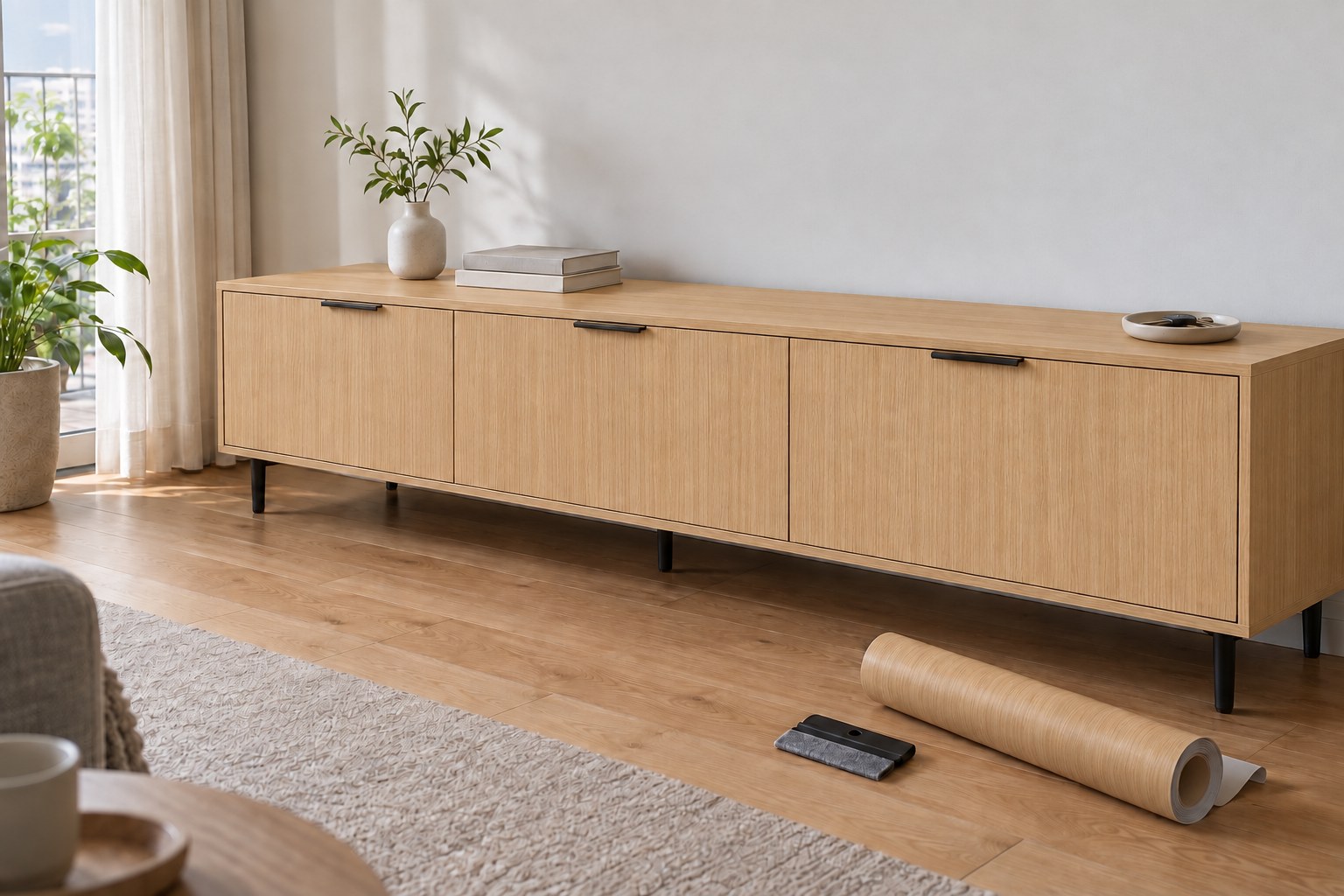
Staged image. Colour: AW005 (wood colour range)
Furniture is the home ground of film refacing. Kitchens, refrigerators, and entrance doors all force you to work on standing surfaces; furniture lets you take the doors and drawer fronts off and lay them flat on the floor. A flat, horizontal panel is the best condition film ever gets, which makes furniture the easiest place for a first success. It is also the natural territory for renters: the furniture is yours even when the walls aren't. The shared technique is in our kitchen cabinet guide; here is what furniture changes.
Good candidates and poor ones
Good: dresser and cabinet fronts and carcasses, bookcase side panels, built-in wardrobe doors, headboards, flat-dominated surfaces. Refacing the one or two planes the eye lands on makes the whole piece read as new.
Think twice: desk tops and dining tables take writing pressure, friction, and hot objects daily, a hostile environment for any surface film. Deeply carved display cabinets, rattan, and fabric are outside film territory altogether.
Furniture's own gate: bare MDF and particleboard where the factory coating is gone. An absorbent face drinks adhesive like a sponge, and film applied straight onto it lifts later. The answer is primer, in step 2.
Step by step
Staged renders keyed to a physical swatch (AW005).
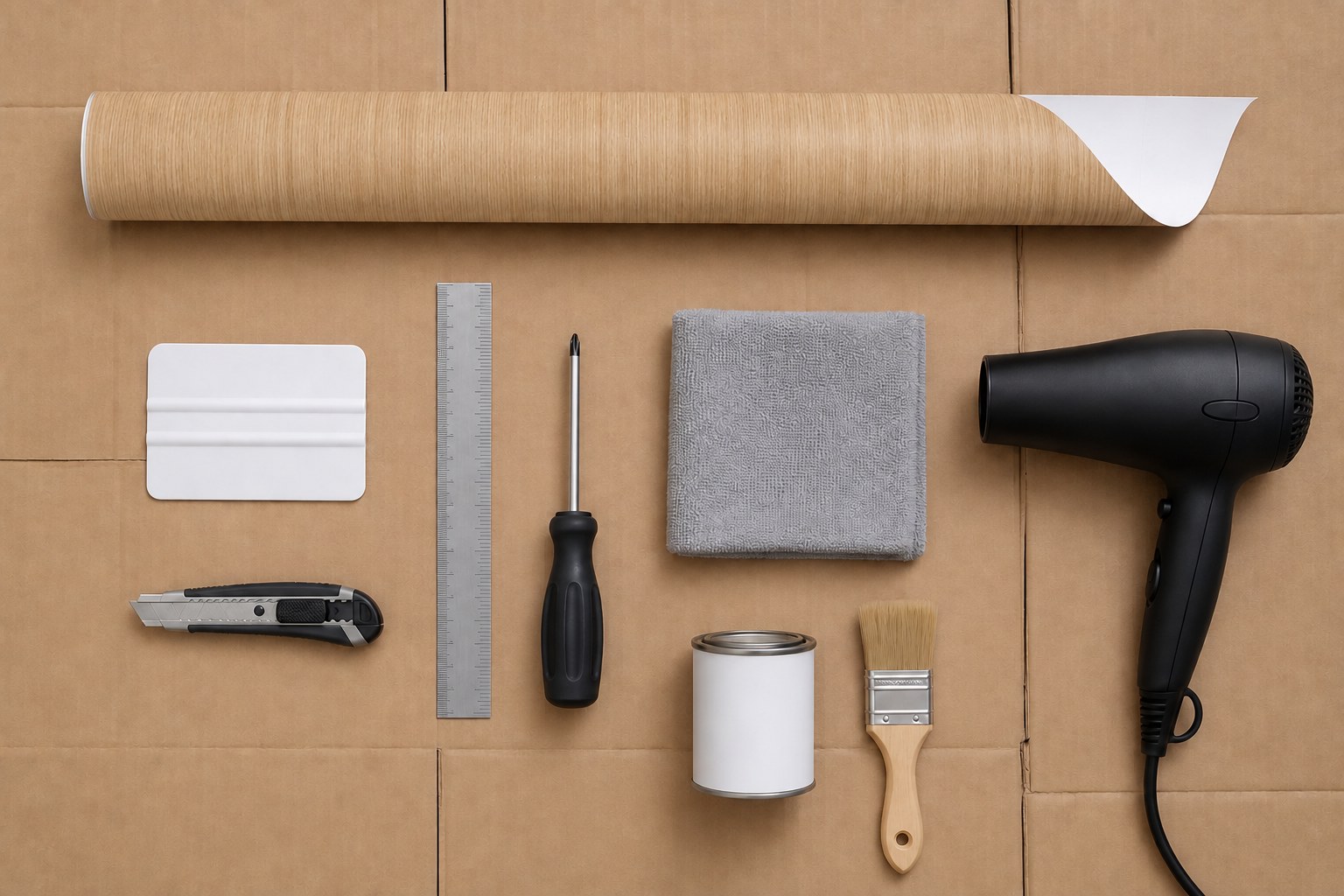 Step 1 · Tools. The standard kit, plus water-based primer and a brush.
1. Gather the tools. Film, squeegee, knife, ruler, screwdriver, cloth, hair dryer, the same as everywhere else. Furniture adds water-based primer and a brush.
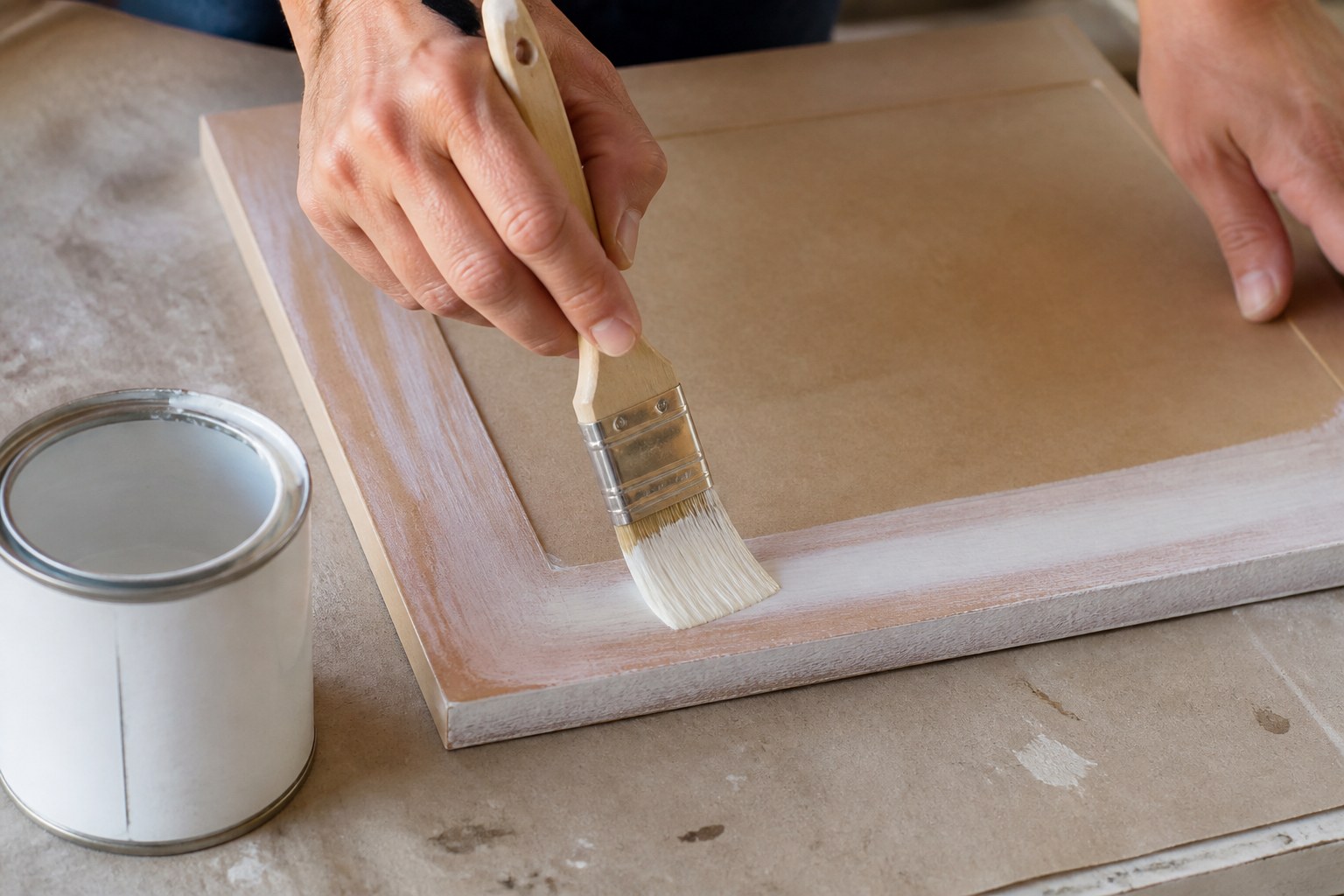 Step 2 · Primer. It turns an absorbent face into a bondable one; edges get an extra coat.
2. Disassemble and build the substrate. Doors off their hinges, drawers out of the carcass, handles off, screws bagged and photographed. Wash with neutral detergent and dry fully. An intact factory coating needs only an alcohol wipe; bare MDF, particleboard, or sanded-through patches need one or two coats of water-based primer, with an extra pass on the edges, then complete drying. Film over damp primer is film on a wet wall.
3. Set the grain, then cut. The 3–5 cm margin rule is universal; furniture adds grain continuity. Cut the fronts of a three-drawer stack from the same roll in sequence, and the wood grain flows top to bottom once reassembled. Mismatched grain between drawers is what makes a reface look like a reface.
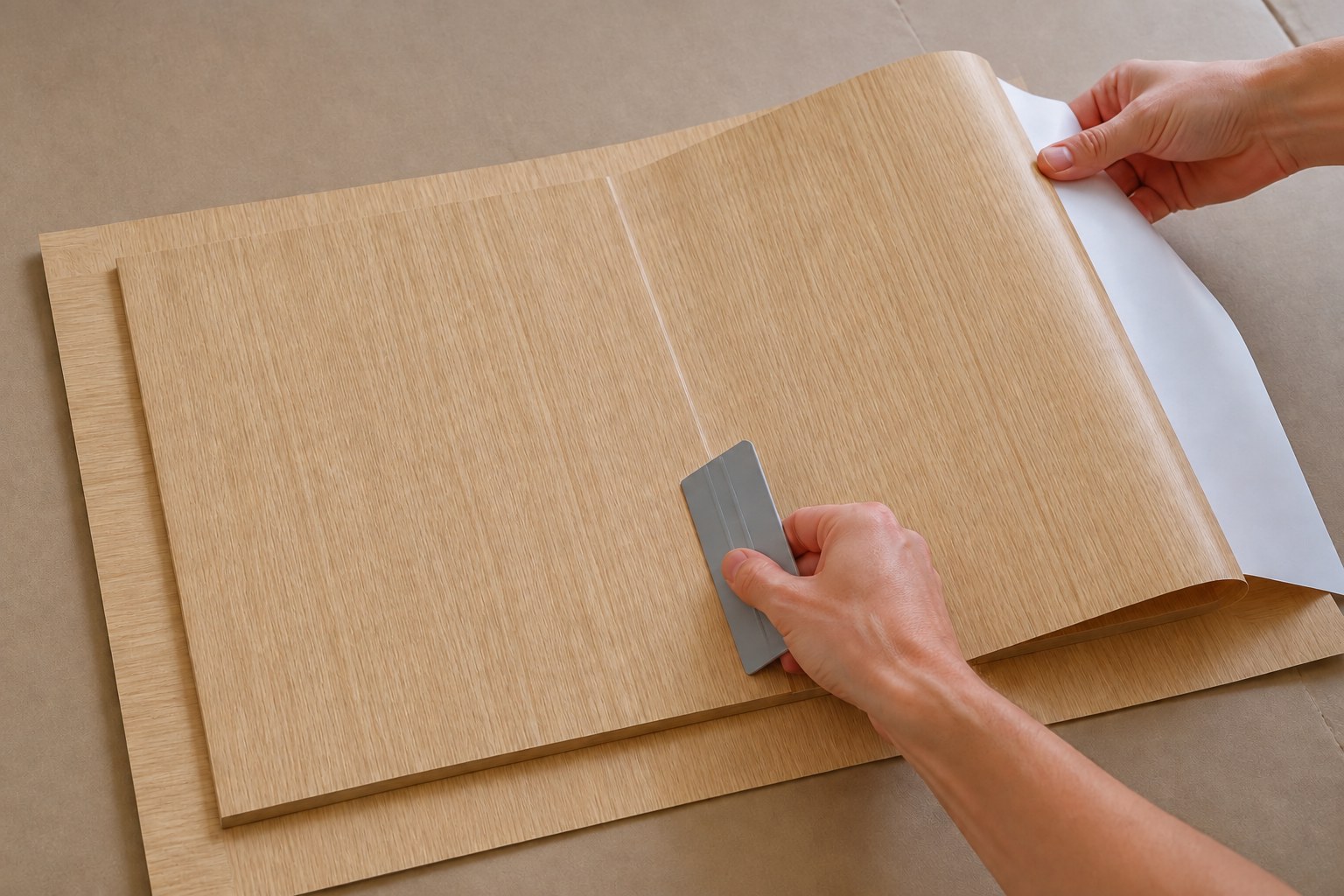 Step 4 · Apply. A flat panel is the best condition film ever gets.
4. Apply flat. Peel 5–10 cm of liner, register the sheet on the panel edge, then peel gradually while drawing the squeegee in one direction, blade parallel to the adhesion line, body upright, scraping rather than rubbing. Nothing sags on a flat panel, so this works calmly with one pair of hands.
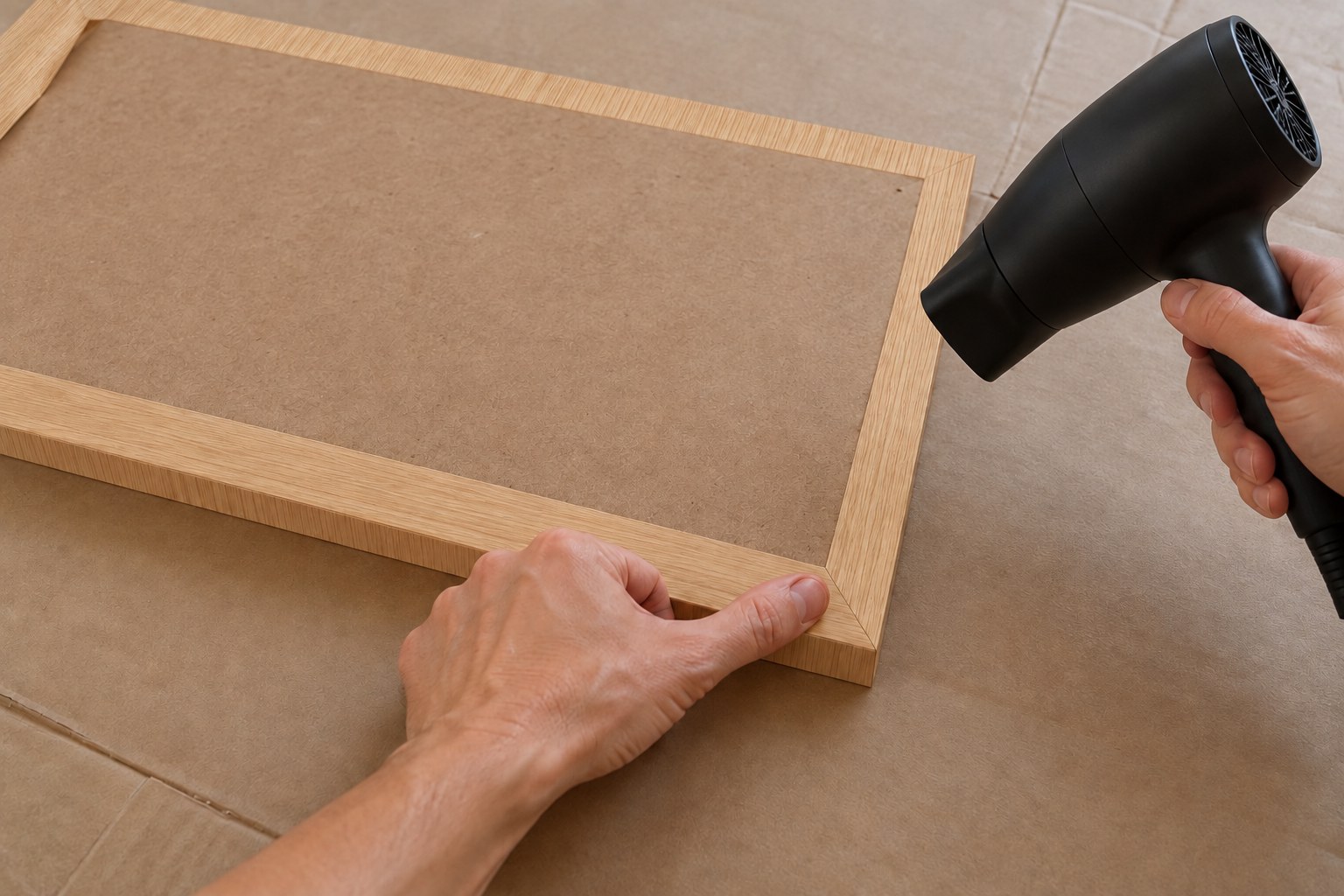 Step 5 · Edge wrapping. Furniture quality is decided at the corners.
5. Wrap the edges and reassemble. Fold the margins to the back face, giving each corner 3–5 seconds of gentle heat from a distance before the hard press. Find the handle holes from behind and pierce small openings through them; refit the hardware. Hold off wet-wiping for a day or two, and give the corners one more press the next day.
A note on the material
Most furniture wrap on the market is PVC. Art-Eco, the Hansol line we distribute, uses a food-container-grade PP substrate with no phthalate plasticisers. Hansol Art-Eco and Neotec SAVE, both of which we supply, are the only lines in Korea's self-adhesive sheet category with KFI quasi-non-combustible certification. On the surfaces people live closest to, a child's room, a bedside, a material whose composition and rating can be verified is a reasonable preference. Certificates are in our documentation; colours in context are in the lookbook.
FAQ
Q. I rent. Will removal restore the original surface? It depends on the substrate and how long the film has been on. Intact factory coatings tend to come back clean; weak substrates like bare MDF can lose surface material on removal. Test an inconspicuous spot first. That is our field recommendation, not a manufacturer specification.
Q. Can I skip the primer? On an intact, smooth coating, yes, degreasing is enough. Primer is mandatory only on absorbent faces: bare MDF and particleboard. Skip it there and the film appears to bond, then returns as lifting.
For product and import enquiries, contact us.
YEILDECO
Fire-rated, PVC-free architectural film
Semi-non-combustible (KFI-certified), PVC-free interior film from Korea. We welcome distributor and export inquiries.