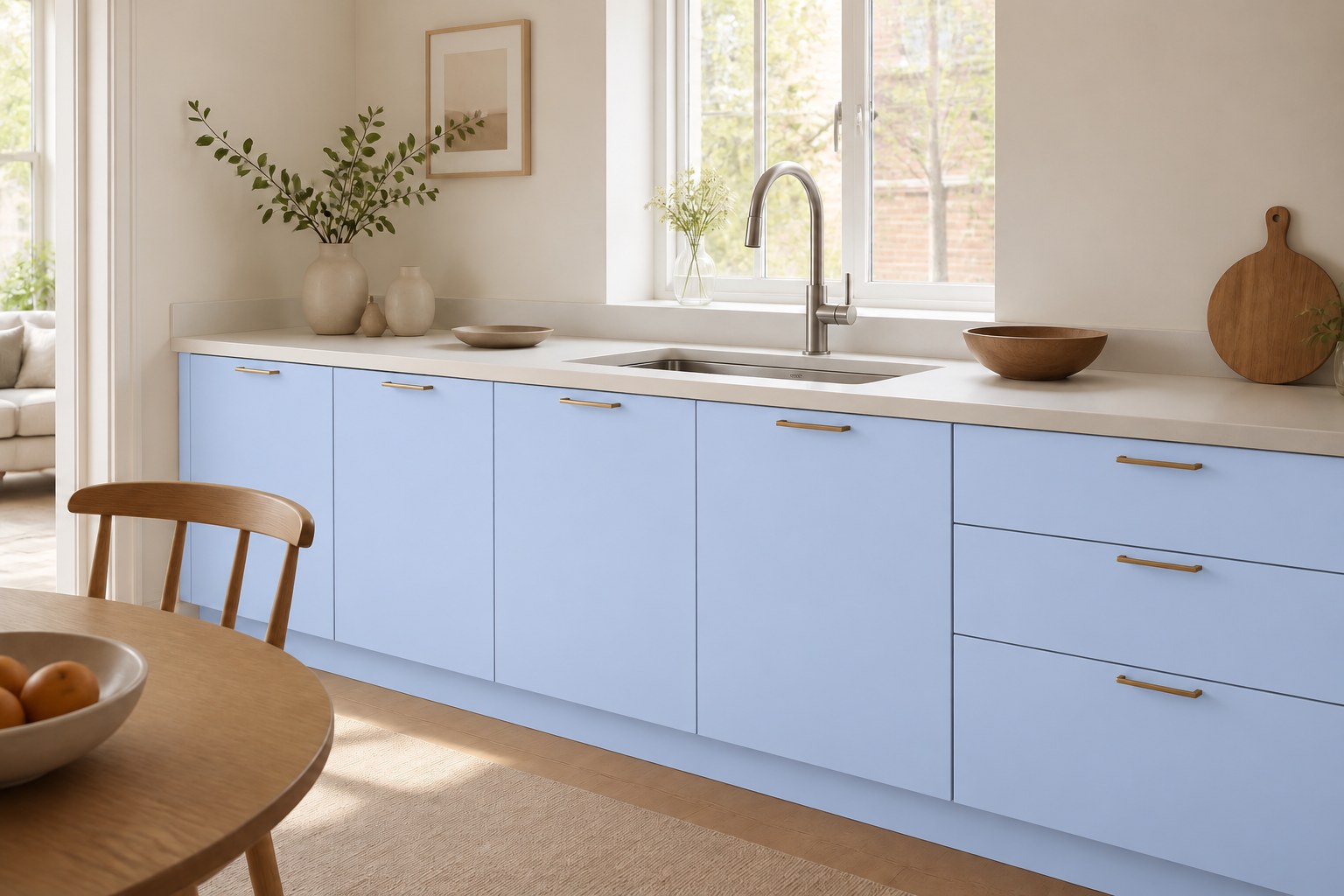
Staged image. Colour: AS021M (full colour range)
Refacing kitchen cabinets with self-adhesive film, often called peel-and-stick cabinet wrap, renews the doors and boxes without demolition. It is the same category of material professionals specify as architectural finish film. The first decision is not colour but territory: knowing where film belongs and where it doesn't is what separates a clean result from a peeling one.
Where film works: doors, boxes, side panels
Doors are the centre of the job. They come off their hinges and lie flat, which is the easiest condition for film to bond well, and a mistake costs you one door, not the kitchen. Remove handles and hinges and refit them in the same holes afterwards. Cabinet boxes and side panels are worked upright, but they are mostly flat, so they remain stable territory.
Where it doesn't
Worktops are not film territory. Knife tips, hot pans, and standing moisture pass over them daily. Film is a surface finish, not a work surface.
Standing water is the shared weakness of every self-adhesive film. Moisture that reaches the adhesive line leads to lifting. That means the sink bowl rim and the drain surround are out; plan your cuts to stop short and seal the water path instead.
Deeply profiled or curved doors are a different level of difficulty. Dimensionally stable sheets resist being forced into deep contours; the manufacturer's application manual for the film we distribute calls for splitting complex curvature into overlapping sections. Treat those doors as professional territory.
The three steps that decide the outcome
- Primer and full drying. On absorbent or worn substrates, apply diluted water-based primer in two or three coats and let it dry completely. Film applied over damp primer fails from below.
- Pressure. PP-based sheets such as the Art-Eco line we distribute need roughly twice the application pressure of a common PVC film, worked in the direction of the grain.
- Heat on corners. The material has strong shape memory. Warm corners with a heat gun from at least 20 cm away, then fold and press hard. Edge quality is door quality.
Work at a room temperature of 18–24°C. Full adhesive cure takes 15 days to 6 months depending on site conditions (manufacturer's application manual).
A note on the material
Most decorative films on the market are PVC. Art-Eco, the Hansol line we distribute, uses a food-container-grade PP olefin substrate with no phthalate plasticisers. Hansol Art-Eco and Neotec SAVE, both of which we supply, are the only lines in Korea's self-adhesive sheet category with KFI quasi-non-combustible certification. The certificates are published in our documentation; how such fire ratings translate across markets is covered in our import checklist.
DIY or professional?
A few flat doors are a reasonable first project. Profiled doors, long side panels that need seams, and wet-area detailing belong to professional applicators. For product and import enquiries from overseas, contact us; email works best, and we respond with market- and volume-specific answers.
FAQ
Q. How long does it last? The "5–8 years" figure in manufacturer literature is a storage-quality window from the production date, not a service-life promise. Installed life depends on substrate, workmanship, and environment, so we don't quote a single number.
Q. Can I apply film over an existing film? If the old layer is fully bonded with no lifting, yes, after surface preparation. Over a lifting or peeling layer, no: strip it and rebuild the substrate first.
YEILDECO
Fire-rated, PVC-free architectural film
Semi-non-combustible (KFI-certified), PVC-free interior film from Korea. We welcome distributor and export inquiries.