A commercial fit-out has two constraints a home renovation does not. The business cannot close for long, and the building's use brings fire rules with it. Film answers both. Installers can work at night or one section at a time, so a clinic or a shop keeps trading, and the certified lines cover the areas where a code asks for a fire grade. This guide goes through the areas by building type first, then through the rules.
Where film goes, by building type
Hospitals and clinics. Corridor walls, patient-room walls, door frames and doors, reception counters. Our project gallery includes a paediatric clinic where we covered the corridor, the lobby and a feature wall. Korea places medical facilities in a strictly regulated group, since many patients there cannot evacuate on their own.
Schools. Classroom walls, corridors, library shelving and refurbishment programmes. Schools are the largest group in our supply records, and the elementary school remodel case study walks through one project room by room.
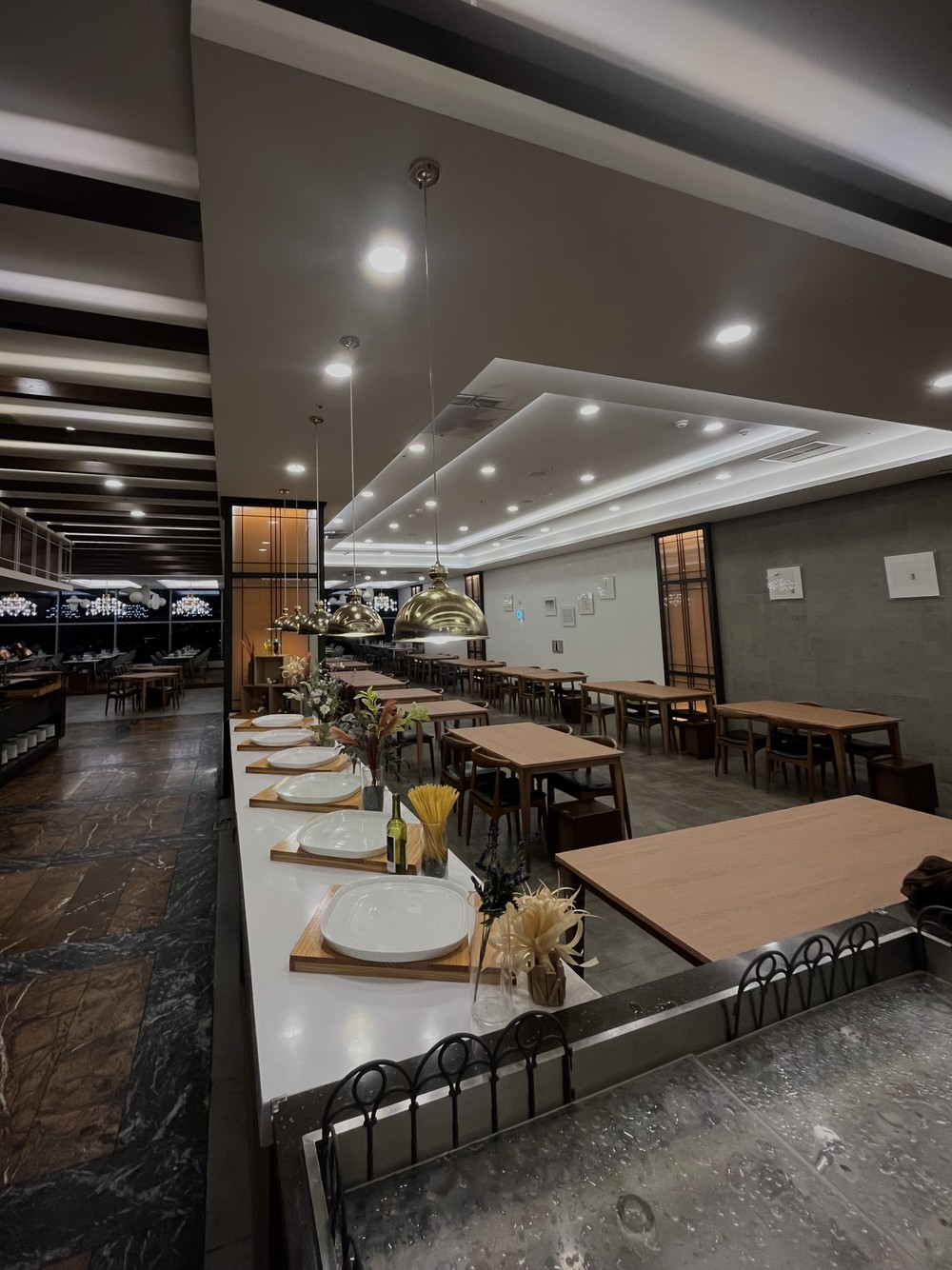
Hotels and food service. Guest-room doors, restaurant tables and fixtures, lobby walls. A recent job: the dressing rooms of a luxury resort's guest rooms, finished in Neotec SAVE NSPE-W1032, a dark wood whose grain stays matte under the shelf lighting.
Offices. Meeting-room feature walls, executive rooms, partitions and storage doors. The corporate new-build case study shows two decors across a whole building.
Retail and entertainment. Wall and column wraps, counters, lift lobbies. Karaoke rooms, internet cafés and private academies fall under a separate Korean regime, covered below.
You can filter the full gallery by building type in our projects section.
Which areas need a fire-rated material in Korea
Three situations trigger a grade check on a Korean commercial project.
- The building use is regulated. Article 61 of the Enforcement Decree of the Building Act lists the uses whose wall and ceiling finishes must meet a fire grade, among them medical, educational and retail facilities. If film goes on those walls or ceilings, plan on quasi-non-combustible documents from the start.
- The area is an escape route. Corridors and stair halls carry stricter requirements than ordinary rooms. Lobbies and corridors are also where film goes most often, so we price those areas in the certified line by default.
- The venue is a multi-use business premises. Decorations installed in places such as karaoke rooms, internet cafés and private academies must be non-combustible or quasi-non-combustible as a rule. Flame-retardant treatment is accepted only for plywood and timber, up to an area limit, and the rule can apply to a refit as well as a new build.
Counters, fixtures and furniture doors fall outside these rules in most cases. On a typical site we split the specification: walls, ceilings and escape routes in the certified line, fixtures and furniture in whichever line suits the design.
Checking the same areas against your own code
Your market has its own version of these three triggers, and the class it requires can sit above what any film reaches.
- United States. The IBC ties flame-spread classes to location and holds exits to the higher classes. Our Class A and Euroclass explainer sets out both systems.
- Germany. The model building code (MBO) asks for non-combustible linings (class A) on the walls and ceilings of required corridors and stair enclosures. Quasi-non-combustible describes a low, capped heat release, and it stays below non-combustible, so decorative film has no place on those surfaces.
- Japan. The interior finish rules (内装制限) set the grade by building and by area, and a Korean KFI certificate does not replace a Japanese ministerial approval (大臣認定).
Our certificate is Korean. We do not hold EN 13501-1 or ASTM E84 classifications, and we can arrange testing to your local standard on request. Our equivalence guide shows how the KFI grade compares with other systems and where the comparison stops.
Work in this order: identify the area, find the class your code requires there, then choose the product.
Documents and samples
A commercial project comes with paperwork for the supervising engineer or the building authority. KFI issues our quasi-non-combustible certificate for the film itself, and you can download the certificate and test report scans from our certificates section. The measured values are broken down in our test report article.
Choose colours from the product range, then check large wall areas against a physical sample before sign-off. For quantities by area and sample requests, send us your drawings.
YEILDECO
Fire-rated, PVC-free architectural film
Semi-non-combustible (KFI-certified), PVC-free interior film from Korea. We welcome distributor and export inquiries.